


The G.O.A.T. 100 #71 | Shinya Hashimoto

Welcome to the G.O.A.T. 100 where we will count down with PWM wrestling historian Peter Edge the 100 greatest wrestlers of all time, based on many different stats and criteria. A new wrestler will be added on Mondays and Thursdays every week. Here is a link to an introduction essay with Peter explaining his GOAT100 concept. At the bottom of the article you can find the GOAT 100 Portal with links to all profiles so far published, as well as a visual key... Enjoy learning more about the history of our great hobby!


If Shawn Michaels or Hulk Hogan are the king of Wrestlemania, and Bruno Sammartino is the king of wrestling in Madison Square Garden, Shinya Hashimoto has to be the pro-wrestling king of the biggest regularly-run wrestling stadium in the world in the 90s, the Tokyo Dome.
The building and Hashimoto have a very eerie correlation. Shinya headlined more successful events in the building than any wrestler in the first 15 years of the Dome's life. The first major break of his career upon returning to Japan (after an excursion to Memphis and Stampede – working under the names SHOGUN and Hashif Khan) saw the 23 year-old reappear for New Japan at the first pro-wrestling event ever in the just-opened Tokyo Dome.
Hashimoto appeared in a tournament for the vacant IWGP Heavyweight title, and scored a win that put him on the map, pinning Riki Choshu, the top guy in NJPW – in the first round. He ended up losing in the finals to Big Van Vader.
He was in the main event of the first New Japan sellout of the building on 1990.2.10 where he teamed with Masahiro Chono in a losing effort to Antonio Inoki & Seiji Sakaguchi – two of New Japan’s founding fathers.
At the time it was the first pro-wrestling event ever to top $3 million at the gate – with Hogan vs. Warrior at Toronto SkyDome at WrestleMania VI just two months later being the second. (And before you ask, WrestleMania III was a gate of just $1.6 million.)
Named one of the Three Musketeers alongside Keiji Muto and Masahiro Chono, Shinya worked in those days in the tag division, teaming with Masa Saito to win the tag titles off Riki Choshu and Takayuki Iizuka before Chono and Muto beat them for the belts after Hash’s and Saito’s 219 days with the tiles
The Musketeers broke through and cemented their cases as the guys competing for the ace position of New Japan in the 1991 G1 Climax – the first iteration of the annual Heavyweight singles tournament to use that name. Muto and Chono won their respective blocks (4 men in each block) to face each other in the final match – while Hashimoto didn’t get into the final after losing to Chono in a play-in decider after the pair finished on 7 points each with 2-1-1
records with the one draw being against each other.

Hashimoto’s victory over Muta for the IWGP Championship would start a stranglehold on the title that lasted into 1995 with only a brief interruption by Tatsumi Fujinami’s penultimate title reign.
During the mid-90s heyday of New Japan Pro Wrestling in the Tokyo Dome building, he was its most frequent main eventer, and sold it out more often than anyone else on top, adding up to headlining more stadium/dome shows than any wrestler in history.
A total of 13 major shows where his match was built as the biggest match on the card, topped the 40,000 mark, 11 of them were main events. Why was this? In a land where the vision of the art of wrestling was that it was a struggle through sport, Hashimoto’s record of success was due to being someone that the fans believed in to win that struggle and who they would cheer to the rooftops, wanting their man to win.

The other two Musketeers helped as well. But it would be the difference in the three guys' characters that made them such captivating bedfellows at the top of New Japan.
The trio that graduated from the 1984 class of the New Japan dojo would be sent to various parts of the United States. While Hashimoto worked in Memphis and Calgary, Chono was in the Central States territory and Muto would appear in Dallas in the final year of World Class Championship Wrestling before it was integrated into Jerry Jarrett’s USWA, but had his biggest success when he was with WCW in 1989, in programs against Sting and Ric Flair – coming back with a huge edge over the other two standouts out of the New Japan dojo, due to that mainstream exposure.

Muto was considered the flashy one, as he popularized the moonsault and handspring elbow, which made him look so unique from anyone in the Big Two promotions in the States, transferring those skills (thought of as Junior Heavyweight style) to the heavyweight division, which set him apart. Meanwhile Chono dressed in all black, giving him an anti-hero look. He ended up relying on mat work rather than dazzling moves, a style change that was necessitated by a broken neck suffered in a match against Steve Austin when Austin did a sit-down piledriver when Chono was in position for the falling to the knees Undertaker-style Tombstone piledriver (I know what you’re all thinking: ironically, yes – the exact same circumstance that led to Owen breaking Austin's neck five years later.) Hashimoto, due to his strike-based offense with his insane hard kicks, got over as the badass of the three.

Hashimoto would be the second of the Musketeers to hold New Japan’s grandest prize, beating his fellow dojo trainee, Muto – while Keiji was in his Great Muta “alter-ego”. His first Dome show as IWGP Champ didn’t see Shinya in the No.1 marquee match with Genichiro Tenryu and Antonio Inoki’s main event being the attraction of the night but the curiosity of Hashimoto facing Masa Chono for the first time in almost two years and the first match after Chono’s 1992 G1 Climax win that cemented his place in the top tier of the New Japan roster was there for the fans.
Shinya’s win on the night thanks to a jumping DDT was one of four successful defences with Chono joining Muto (in a rematch under the Muto name), Scott Norton, Kensuke Sasaki (in his Power Warrior gimmick) all joining Masa as notches on Shinya’s record before the title switches with Fujinami. Hashimoto came out stronger after the losing and regaining the title, because just a month after losing to Fujinami by cradle with the ref missing a rope break, Shinya destroyed Tatsumi in just 364 seconds to start title reign #2
Title reigns 2 and 3 saw a combined 16 defences. #2 would see a ****½ star match against Hiroshi Hase, a match against Kensuke Sasaki that was the main attraction of the 1.4 Dome show that kicked off 1995, and a defence against Steven / William Regal that is the best match of the Blackpool native’s career. But it’s reign No.3 that made Hashimoto.
It started as he avenged New Japan’s loss of the title to regain the IWGP from the UWFI promotion that was in its last legs, after Nobuhiko Takada had beaten Keiji Muto to steal away the World title on Jan 4th, in the NJPW vs UWFI storyline that many say was the basis of WCW vs. NWO storyline (but was more an inter-promotional battle of two franchises rather than the internecine blood war that WCW vs NWO would come to be.)

Hashimoto accomplished this before a sold out Tokyo Dome on April 29, 1996, by beating the submission specialist, Takada, with an armbar and a tap out. The $5.7 million gate is among the biggest in history. For comparison, WrestleMania X-7’s live gate is $6.3 million.
Hashimoto kept the IWGP title until August 31, 1997, when he lost to Kensuke Sasaki at the Yokohama Arena. The 489 days with the belt – in its v2 era with the king crown thorns at the top of the belt now synonymous with Shinya – was the longest reign anyone had with the championship to date, and would keep that record until Kazuchika Okada's reign in 2016-2018.
A 1.4 Dome main event against Riki Choshu, saw Riki – the booker of the company – put Shinya over big time by letting Hashimoto beat him very decisively. This was his finest hour as champ.
But it was Hashimoto’s credibility as a tough guy that was used by Inoki (still the owner and still able to get his booker to create his vision) to try to turn 4-time World Champion judoka and 1992 Barcelona Olympics silver medalist Naoya Ogawa into a new mainstream star.
Hashimoto and Ogawa would main event the Battle Formation show at the Tokyo Dome on 97.4.12 in a non-title match, in which Ogawa pulled off the shock win by making Hash pass out with rear naked choke. But then three weeks later got his win back, this time with the title on the line, in a knockout win after a punt to the head.
After a Hiroyoshi Tenzan main event at the Nagoya Dome that was one of the 40,000+ attendance shows that Hashimoto has under his belt, Kensuke Sasaki was the one to end the historic Hashimoto reign that saw three defences in three different Domes and three 40,000+ attendances.

Post championship Hashimoto would face Dennis Lane, a MMA practitioner of such fame (he doesn’t have a wikipedia page) in a match at the 1998 Jan 4th show that went 1:34 in length. This inauspicious start led to a year that actually turned out to be his best year in the ring. But the start of the following year saw one of the most controversial matches in puroresu history.
That match took place at New Japan’s annual January 4th show in 1999 (that day was insane wasn't it) Although it was not the main event, the match was unforgettable, arguably Japan’s equivalent to the end of the 1997 Survivor Series – a match where the post-match intrigue was bigger than the match itself. Unlike that night in Montreal, it was followed up, and while many suspected it to have been a double-cross on Hashimoto, it was actually a planned-for shoot between the two… because Inoki.
Ogawa had been training hard on his kickboxing, and while Hashimoto was thought to be tough, Inoki thought Ogawa was tougher, was doing real training and was thus in far better shape. Inoki just simply told Ogawa to go all out. It later came out he was told ahead of time this was going to be a shoot-style match with a predetermined finish and if Hashimoto got in trouble, he could hit the referee to end it as a no contest.
However, nobody else was informed, and the wrestlers in back freaked out at what happened. The match lasted just shy of seven minutes, all of it with Ogawa just beating Hashimoto in a one-sided battle. It was brutal with Ogawa both attacking Hashimoto’s spine and kicking him hard in the face before Hashimoto decided it was time to end it by knocking the ref down. Ogawa was an instant superstar because the public believed it was real, and because it was so one-sided. The idea was that New Japan would build him for a match with Rickson Gracie, one of the storied Jiu-jitsu family that has been associated with the combat sports history of Japan since the 1920s. It would be one of if not the biggest money match of all-time for NJPW, and the hope was that the more Ogawa improved at MMA, he could actually win the fight. But the idea of what they were building to never came close to fruition.

But it did set the stage for Ogawa to be a featured star in New Japan for years. Along with the NJPW/UWFI feud, Hashimoto was part of setting the stage for the beginnings of more realistic-looking matches. But (because wrestling and because Antonio Inoki) this style of matches became overdone and ran their course quickly, and were being booked long past when they had lost their steam.
Hashimoto-Ogawa was super hot at the time and Jan 4th in the Dome led to a climactic match which was the most watched pro wrestling match on television anywhere in the world in more than a decade. Even more than anything seen in the Monday Night War.
The monster couldn't be controlled though. Ogawa fell out of favor with New Japan because he refused to be professional in a tag match involving Riki Choshu. But in a year's period, Hashimoto and Ogawa had three more memorable matches in what was the hottest program in Japan of its time.
The ironic thing is that it was supposed to be Ken Shamrock in the role of Ogawa for the 97.4.12 Dome show and work a feud with Hashimoto in which he and Hash would exchange wins and Ken would hold the IWGP Heavyweight Title but WWF got Shamrock to join them instead, leaving NJPW with a Tokyo Dome and no opponent for Hashimoto. Enter Ogawa.
The fourth match between the pair was on the October show at the Dome before a reported 58,000 fans (although NJPW adding 10,000 to the actual gate was a 90s tradition as common as Shawn Michaels being on WWF television while off his tits) with Ogawa retaining the NWA Worlds Heavyweight Title that he had taken from Dan Severn to end his 4-year reign back in March.
The bout was stiff as hell, with a lot of MMA tropes in the match but with Hashimoto’s wrestling mannerisms mixed in – with Hashimoto taking off his grappling gloves to start a comeback with bare-knuckle punches. Ogawa finally hit his STO, and began punching and kicking Hashimoto at will until Inoki jumped in to stop the fight, a finish built off the famous Andre the Giant vs. Akira Maeda match, which turned into a shoot, and ended when Inoki jumped in the ring to stop it.
However, fans in the building hated the finish, as people wanted a clear winner, not a stoppage based on a guy not defending himself and taking punishment.
Nonetheless, the two would still sell out the Dome 365 days after the infamous “shoot”. Although not positioned as the main event, they were clearly the big draw on the show ahead of the actual last match of Kensuke Sasaki and Genichiro Tenryu for the IWGP Title.
They did another match that was a “worked shoot”. They didn’t overplay the drama that they built in their last couple of singles matches in a tag match that tore the house down with Hashimoto & Takashi Iizuka beating Ogawa & Kazunari Murakami. This match started out as being completely out of control, as Murakami got Iizuka on the ground and was punching him from the mount until he knocked him out. It turned into a “bench clearing brawl” and was ruled a no contest in 2:24. Inoki came in the ring again and yelled at all the participants and the match would restart and Iizuka tapped out Murakami at 11:29.
Hashimoto challenged Ogawa to another singles match in the aftermath – for a special Tokyo Dome show on April 7, 2000, in what was a rare live network-TV special.

By the standards of New Japan Tokyo Dome events at this time, it wasn’t a big draw in the live gate. Legitimately, there were probably closer to 40,000 fans in the building, although it was promoted more as a live network special on TV Asahi on a Friday night than as a live event. All of the hype at the time was based on the return of Friday night wrestling, a fixture from the 80s, and also Hashimoto vowing to retire if he didn’t get his revenge and beat Ogawa.
Hashimoto vs. Ogawa drew 34 million viewers with a 24% share of the TV audience. It was the single most watched pro-wrestling match on television in the world (even more people watched this than Hogan vs. Andre on NBC in 1988) since the Antonio Inoki vs. Leon Spinks match in 1986.
Of course it was built for Hashimoto to finally get his win. And the fans knew it. On the live special, they had a phone poll, with more than one million phone calls coming to vote and about two-thirds expected Hashimoto would win. But when Inoki got to the Tokyo Dome, he changed the finish. His reasoning wasn’t because people expected Hashimoto to win, but his feeling that Ogawa had surpassed Hashimoto as a television star, and he needed to protect him more because he had more potential to make big money than the (in Inoki’s opinion) increasingly less-marketable Hashimoto.
With Antonio Inoki, (representing Ogawa) and New Japan president Seiji Sakaguchi (representing Hashimoto) at ringside, it was a battle of hard kicks vs. judo throws, with Ogawa winning via ten count knockout using the STO.
Even Ogawa questioned Inoki’s decision, thinking it was his time to lose, and he was more than willing to put Hashimoto over. And the loss meant for the moment that Hashimoto was majorly screwed.
He had to take time off to sell the retirement. He did come back on 2000.10.9, in the opening match at the Dome with the stipulation more or less ignored. Sasaki had taken his spot as New Japan’s representative when it came to fighting outsiders from other promotions, as the Dome was sold out for the dream match of New Japan’s top star against All Japan’s top star (Toshiaki Kawada) for the first time in history.
Then in November, Hashimoto was fired by New Japan.
This was considered as one of the three biggest firings in the history of wrestling in Japan along with JWA’s firing of Inoki in 1971 when he failed in a power play to take over the company, and New Japan’s firing of Akira Maeda in 1988 after Maeda failed to accept any punishment for doing a shoot kick to Riki Choshu several months earlier.
There was resentment among the wrestlers that Hashimoto was drawing his $400,000 per year salary, but rarely wrestling, since they had to keep him out of action due to the retirement stipulation, plus they had done an angle where he was not doing the small towns in the tours to make the Ogawa matches on the Dome shows bigger. He only worked three matches for the company in the year 2000, all at the Dome.
Choshu was mad Hashimoto was reluctant to put over Manabu Nakanishi and Yuji Nagata upon his return. He was grooming Nakanishi and Nagata to be the next big stars. Choshu himself wanted Nakanishi to beat Hashimoto in his return from losing the retirement match, but Tatsumi Fujinami volunteered to lose to Hashimoto, feeling another loss at that point would have destroyed Hashimoto as a draw.
At a four-hour booking meeting the day before the shocking announcement, Choshu, Sasaki, Chono, Shiro Koshinaka and Katsuji Nagashima all voted to fire Hashimoto. Fujinami was the only one to vote to keep him.
The thing is, Hashimoto had been talking to Mitsuharu Misawa for five months, and it was known internally, with the feeling he was going to leave anyway when his contract was up.
Hashimoto ended up opening up the Zero-One gym, and was going to run his own shows for a promotion by the same name. Striking up working relationships with All Japan and Pro Wrestling NOAH, Zero-One became No. 4 on the totem pole of male wrestling companies in Japan. Shinya would end up holding the NWA Worlds Heavyweight Championship beating Steve Corino, with Corino ending up as a top foreigner in Zero-One. Britain’s Gary Steele then came in and fought the two in a three-way to claim the belt.
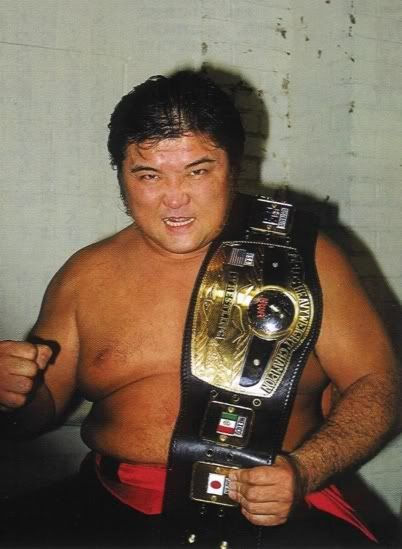
Shinya would appear in NOAH and AJPW as well, winning the Triple Crown, beating Muto on 2003.2.23 with Hash being the champion for one day short of a full year before losing the Triple Crown to Toshiaki Kawada.
And Shinya would get to return to the New Japan ring, teaming with Ogawa as the pair were now tag team partners in Zero-One and they would be defending New Japan against the antics of the top heel faction Team 2000 led by Masa Chono as the team wrestled Scott Norton and Hiroyoshi Tenzan.
But his beaten-up body was seeing Hashimoto at this point mostly wrestling tag matches, one being the main event of the third Hustle PPV with Hashimoto and Ogawa facing Kevin Nash and Scott Hall. But by year's end, Shinya was out of the promotion that he founded, claiming financial problems.
Hashimoto would be found unconscious at his home on July 11, 2005. He was pronounced dead at 10:36 a.m. while en route to the hospital. Hashimoto's sister Masanari claimed that Hashimoto had been complaining about chest pains and thought that his heart was beating too fast a week prior to his death, but refused to contact his doctor about the conditions. Those ailments were the beginning of the end for one of the biggest names ebery in puroresu.
The second design of the IWGP Heavyweight Title was retired not long after in tribute to the man who is associated with the glory days of v2 of the belt, and his follow musketeer, Masa Chono cemented his nickname of Mr. August with his fifth G1 Climax victory, all in the memory of his comrade. If The Musketeers of New Japan were now divided, Chono’s actions that night in August 2005 meant they would be always united when they wrestled.

Four months after the death of Hashimoto, Antonio Inoki sold his shares in New Japan to Yukes. Was it coincidence, fate or inevitable that the father of New Japan would sell up months after the heart and soul of the most prosperous era of his company died?
Was it coincidence, fate or inevitable that the Tokyo Dome would be built and Shinya Hashimoto came along to be king of that building?
Shinya Hashimoto was perfect for the era he was king of, but he could've thrived in almost any era. He was the realized vision for what Inoki saw in wrestling – but his charisma would also have been perfect for the 5-star era of New Japan, post-2014. Yes, the stars were more often 3.5 than 5 when he was in the squared circle in Japan’s biggest arenas, but the numbers that went through the turnstiles didn’t lie, proving the success of Shinya Hashimoto.
G.O.A.T. 100 Portal
Links to all GOAT100 profiles published so far
G.O.A.T. 100 Image Grid


Comments