.png)


The G.O.A.T. 100 #97 | Akira Taue

Updated: May 24
Welcome to the G.O.A.T. 100 where we will count down with PWM wrestling historian Peter Edge the 100 greatest wrestlers of all time, based on many different stats and criteria. A new wrestler will be added on Mondays and Thursdays every week. Here is a link to an introduction essay with Peter explaining his GOAT100 concept. At the bottom of the article you can find the GOAT 100 Portal with links to all profiles so far published, as well as a visual key... Enjoy learning more about the history of our great hobby!
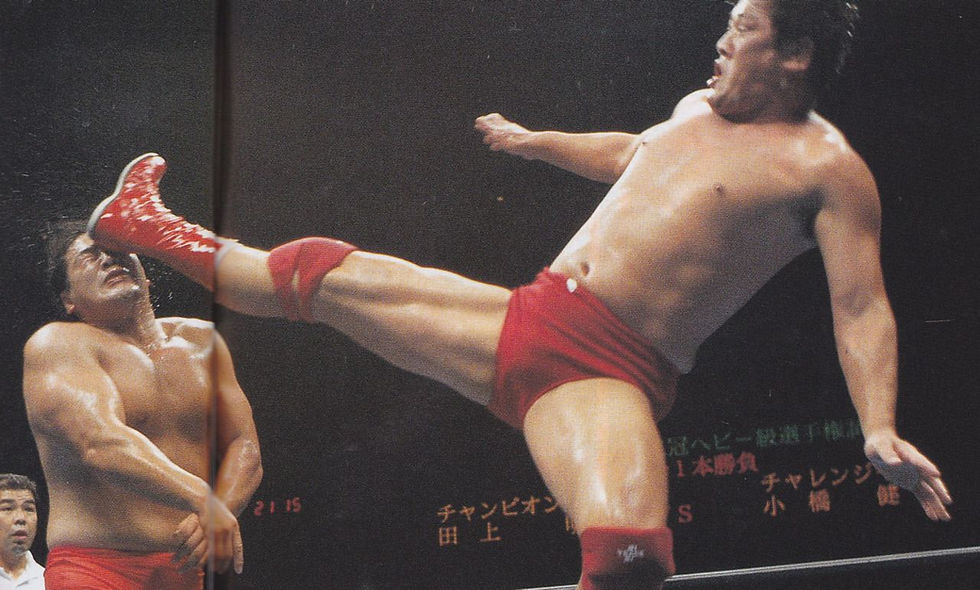

Your first presumption is probably “Pete only put Akira Taue in this 100 because he wanted to put all Four Pillars into the list,” I’m guessing.
Yes, but also no.

I remember listening to a podcast that was looking back at Meltzer 5 star matches and hearing one of the hosts call Taue "the Ringo Starr of the Four Pillars." That’s harsh. (To use Ringo as a dis, I mean.) Ringo Starr voiced Thomas The Tank Engine and out of the three Beatles that had the opportunity, produced the best guest appearance on The Simpsons (and one of the best of all time).
Seriously, I could do 1,000 words on how bad Paul McCartney’s cameo on The Simpsons was and how it – and the "Lisa The Vegetarian" episode it featured in – were the true beginning of the end of The Simpsons and not the Seymour Skinner false identity episode.
Like seriously, it’s the episode to make a Simpsons family character really unlikeable (if you ignore the Marge thinking of having an affair episode, because you kind of have to ignore the first season of The Simpsons when it comes to canon) It was the start of a long series of moments where Lisa became the intellectual mouthpiece of the show from an increasing insufferable, pseudo-intellectual room of writers, which only worsened with the Lisa becomes a Buddhist episode. Any moments where she acknowledged her wrongs were instantly rendered meaningless because the party she offended her forgave her anyway for asinine reasons, and her belie…..
Sorry, where was I?
To use a comparison that is better suited to the demo I’m looking to reach with this project: Akira Taue is to the Four Pillars what Andy Murray is to the Big Four of tennis.

Compared to Novak Djokovic, Roger Federer and Rafa Nadal, Andy Murray could never reach the standard of his Big Four peers, yet if you put together a Top 100 of men’s tennis, he ranks highly. Also – setting aside British bias – Andy Murray was the coolest of the Fab Four, and to me Akira Taue will always be the coolest of the Four Pillars.
Misawa looked like a narc, Kobashi was just too good to actually be the coolest, and while I know people will shout that it’s Kawada that's the coolest, Eddie Kingston’s love of Dangerous K is just as over-the-top as CMFTR’s love of Bret Hart. But Akira Taue had that aura of just being cool in my eyes.
Akira was probably the one of the four that their boss Baba originally intended to be the “main character”. He was tall like Baba, he was stocky – an attribute Baba would have loved to have had – but the telltale sign was the red trunks. The color of Baba was the color of Taue – that wasn't a coincidence. But Taue’s lack of the sky-high skill level of the other 3 kings of All Japan meant Taue was never going to be The Guy in a place like AJPW. But the story of the Pillars and of All Japan Pro Wrestling can't run without Akira Taue.
When adjudicating the order for my Top 100, one of the metrics is the amount of Dave Meltzer five-star+ matches a wrestler has got. Taue has 15 in all, but just one of that number is a singles match. Taue’s lone 5-star singles match came against Mitsuharu Misawa, but Taue’s presence in those tag matches is integral. So why is Taue so integral?
Taue didn't enter wrestling until he was 27. He had been an active sumo wrestler for 7 years beforehand, part of the Oshiogawa stable that produced eleven sekitori players – meaning ranked in one of the top two levels of sumo.

Taue ended up being in the jūryō division, the Championship division of sumo, but then seeing his progression falter, he retired from the sport and went into the AJPW dojo. He made his debut on Jan 2, 1988 in a battle royal in the main event of Night 1 of AJPW's annual New Year Giant series (a match won by John Tenta, 18 months out from his move to WWF.)
Taue would spend his first two years primarily in tag matches, with his first title win coming in June 1990 with an All Asian Tag Title win with Shinichi Nakano. This was a transition time for All Japan, after Genichiro Tenryu shockingly leaving for the upstart SWS promotion, taking upper mid-carders such as Yoshi Tatsu and Hiromichi Fuyuki with him. This created an opportunity for the award-winning Tsuruta-gun vs Super Generation Army feud to fill that void.
Taue was part of SGA, along with Misawa, Kobashi and Kawada, but with Tsuruta-gun’s numbers being low, Giant Baba made the booking decision to put Taue into Jumbo Tsuruta’s heel group.

Tsuruta-gun was the establishment. The group that wanted to put the young guns of Misawa, Kobashi, Kawada and Taue back in their place underneath them – so for Taue to go to Tsuruta-gun made him a guaranteed heat missile. There was no visual moment of Akira turning on his teammates. No “Seth Rollins moment,” like in 2014 with his turning on the Shield to join Evolution. Taue just showed up with Tsuruta at an event.
But Taue had heat from the masses from that moment on. Any time he got tagged in, boos would serenade him as he got into the ring. The son-of-a-bitch who betrayed his teammates was public enemy No.1 – Taue would be borderline bullied every time. Kawada and Misawa would always beat him up in the multi-man tags and Taue was the man who would be pinned in Super Generation wins over Tsuruta-gun – but under Jumbo’s learning tree, Taue was a better wrestler coming out of it.
As Jumbo’s partner in Strongest Tag Determination Leagues in 1990 and 1991, he would be in the match of the tournament on both occasions, facing Misawa and Kawada both years, in a ****½ match in ‘90 and and a ****¼ match and ‘91. In all, Taue had four five-star matches and 10 Top Ten placings in my MOTY list in 1990 to 1992.
But then Jumbo Tsuruta was done as a main eventer due to illness. (That story will come when I look at the rest of the ensemble of the King’s Road era of All Japan.) So for a period of time Taue was in limbo.
From the Anniversary Giant Series in October 1992 to the 1993 Champion Carnival, Taue was doing things, but not making an impact. His partnership with rookie Jun Akiyama in the 1992 Tag League did see a couple of notebook matches (vs Steve Williams / Terry Gordy and vs Giant Baba / Kenta Kobashi) and they finished the series with a 6-5 record that year, compared to the 8-3-1 in 1990 and 9-1-2 the year after. (Caveat: two of Tsuruta and Taue's four losses were to the team of Andre the Giant and Baba.) The World’s Strongest Tag Determination League was the premier tournament in wrestling at the time. It was a who’s who of pro wrestling in one tour where Hall of Famers abound and for Taue to be stuck with a rookie – albeit a rookie destined for greatness from day one in Akiyama – was a good sign of the limbo he suffered.
While he did challenge for Mitsuharu Misawa’s Triple Crown and the match had a 7.83 rating on Cagematch, and four stars from Meltzer and yours truly, (signs of a very good match) it was still the second worst of the eight defences in Misawa's two-year run as champ.
Akira Taue would finish 6th in the 13-man round-robin stage of the 1993 Champion Carnival, but while wins against former Triple Crown champion Terry Gordy, Davey Boy Smith and Kenta Kobashi were notable, it was a draw against Toshiaki Kawada that was not just the most important moment of the tour, but also in Four Pillars lore.
Taue vs Kawada was the best match of the round-robin stage. The pair always had great chemistry in their matches. The match the pair had on 1.15.91 is a barn burner and the final match in AJPW to have intentional blood, as Baba would ban the running of the blade not long after. The matches the pair had were heated – anytime Taue and Kawada would be in the ring together, the action would go a couple of notches higher. In storyline, Kawada was the angriest of the Super Generation Army at Taue's betrayal, and he would make him pay for it.
If you were to see what Kawada would do to Taue in the ring anywhere else, it would be classed as bullying, and if you saw Akira stand up for himself, you’d be forgiven for thinking “good for you, Akira”... if he weren’t such a treacherous bastard – and that’s what made the pair shaking hands after their 30-minute time limit draw in their 1993 Carnival match such a surprise.

What followed was an unlikely union between Akira and Toshiaki – The Holy Demon Army was born. Kawada’s jealousy of his S.G.A. leader’s Triple Crown triumph drove the marriage of convenience between the pair. The next few years saw a series of matches between Taue / Kawada and the team of Misawa and Kobashi go down as some of the greatest tag matches of all time.

In all, the quartet had eight tag matches in their rivalry and for each of the Four Pillars of AJPW, one of those eight particularly showcased their strengths: For example, the final match of the 1993 World’s Strongest Tag Determination League was Kobashi’s match, while 95.6.9 is all about Kawada. But 95.1.24 is the Taue show. On this night, Akira is the perfect shithouse. He borderline spams the snake eyes move that gets a boo every time he has done it throughout his career (those Japanese fans saw through Kevin Nash’s bullshit). But Akira also shows the danger to his game with his chokeslam finisher eliciting a scream of fear anytime he threatens to get it on someone. But in storyline, it’s his heart that carries his team out of the doldrums, kicking out of multiple pins, in near falls that get fans to bite. While Kobashi is fantastic in his role of “playing Ricky Morton” in this match, it’s Akira Taue whose performance truly drives this most underrated contest of the Four Pillars tag series. Though if you watch, be wary that you need to get past the first twenty minutes (which is barely whelming) before the greatness comes – making it The Wire Season 2 of the Misawa / Kobashi vs Holy Demon Army series.

This period sees Akira step up in singles action. Getting to the final of the 1995 Champion Carnival, seen by many as the greatest original C2 in history, Akira’s road to the final at Budokan saw him put on crackers against Kenta Kobashi, and a Toshiaki Kawada match on 4.8.95 which would have been his best ever singles match – had the C2 final against Misawa not happened.

Taue is the perfect monster heel, with Misawa's IRL broken orbital bone a perfect point of emphasis. Every time Taue goes for the face elicits proper heat, but anytime Taue tries to execute his finisher from the apron to the floor the masses shriek in horror. The 1995 and 1996 WON Best Wrestling Maneuver might have gone to Rey Mysterio’s “flipdive into a frankensteiner on the outside” and Ultimo Dragon’s Running Liger Bomb respectively, but no move got a reaction from fans like Taue's devastating chokeslam did.
The January 1995 Four Pillars tag wouldn’t be the only one-hour draw that year, with their October 1995 match also going the distance, (reminding me of Eddie Kingston pulling a face when appearing on the Long and Winding Road podcast, when the presenter said that Baba was one of the great bookers of all time.) Now, I like time-limit draws and I love that the Japanese fans of this era didn't mind them either. But after the bell rang in the January match, indicating that Misawa and Kobashi had run out of time, the fans give out a frustrated “argh” – but it is quickly followed up by a round of applause for what they just saw…
Remember, a draw is a legit result in most team sports. But two draws from the same teams in the same calendar year? This showed that Baba was running out of ideas. But with one Pillar left to hold the Triple Crown, Baba played the card he had left, giving Taue a run with the belt in 1996.

The reign lasted only 61 days. Only the first-ever reign, Tsuruta’s 48 days, Terry Gordy’s two reigns (3 and 10 days) and Kawada’s 42 days as champ in 1998 are shorter in the Baba era of AJPW, and Taue was the only of the Pillars to have just one reign with All Japan’s top prize.
Losing the belt to Kenta Kobashi was the start of cementing Taue as the fourth-ranked Pillar. Kawada and Kobashi still had Everests to climb – they had yet to beat Misawa for the Triple Crown. Taue’s win over the ace of All Japan on 6.7.96 made him the first of the others to beat Misawa one-on-one, his successful defences of the belts made him the second to beat the other three Pillars.
Taue would still have great matches with Kawada as his partner, with crackers against Misawa and Jun Akiyama (my 1996 MOTY), Hayabusa and Jinsei Shinzaki, and Kobashi and Johnny Ace… but from 1997 onwards, Taue only had nine notebook matches in singles. Taue’s left knee, ravaged by a ligament injury, was a factor in a final quarter of the decade that just wasn’t on par with what the other 75% of the 90s had been.
Taue was one of the arch movers in the big exodus of wrestlers from All Japan to Pro Wrestling Noah. Giant Baba had passed away after 27 years as the owner of AJPW. Misawa had a falling out with Baba's widow in the 18 months after his death, leading to him founding a rival. Akira would serve on the board of the start-up promotion.
Taue's role in front of the camera would be as a gatekeeper and "tough out” challenger for 3 different GHC champions, helping them to cement their reigns. Until on 11.5.05, he challenged Takeshi Rikiō in what everyone thought was another gatekeeper match to test the young champion – until Taue hit Rikio with Ora Ga Taue, his new finisher which transitioned his chokeslam into a back suplex. The fans – who would have loved to see Taue to beat Rikio, but deep down believed it wasn’t happening – shrieked with joy when the ref’s hand counted to 3.
A mass of people rushed the guardrail like at a poorly stewarded British wrestling show. The man who had been the most loathed of the Pillars – now with a bald spot forming on his head – had made fans delirious with joy, standing with their hands on their heads in disbelief.

Taue would then drop the belt to the guy who was primed to be the next ace of NOAH – Jun Akiyama. The big-time light wouldn’t shine on Akira much after that. Taue only wrestled 2 matches that went north of 10 minutes between the night he dropped the GHC Title on 1.22.06 and his final singles match on Halloween night 2011.
Taue’s standing in NOAH meant he would become President of NOAH after the tragic death of Mitsuharu Misawa in the ring, while Misawa’s widow inherited the majority of shares in the company – which is as ironic as rain on your wedding day. This was a role he held for seven years, until an IT development company called Estbee purchased NOAH after the company was on the verge of bankruptcy. Because he was NOAH’s guarantor during bankruptcy proceedings, he had his personal assets confiscated and took on a personal debt of 400,000,000 yen ($4 million dollars). According to his autobiography he would have to move in with his mother, and take on work sorting packages for a delivery service. (Did he just work in an Amazon warehouse?)
Akira trained to become a chef and opened a steakhouse, mirroring what his Holy Demon Army teammate Kawada had done. Later, Akira fought stomach cancer – needing to have the majority of his stomach removed in surgery – but he would make a full recovery and would still feature on NOAH television as a commentator.

Taue might be the Ringo Starr of the Four Pillars to some, but when you look at his career, he had more than a brush with greatness considering how important he was in the story of the Four Pillars. Without Taue – the main antagonist of AJPW in the 90s – the Four Pillars and the Kings Road don’t happen to the scale that they did.
G.O.A.T. 100 Portal
Links to all GOAT100 profiles published so far
G.O.A.T. 100 Image Grid



Comments