.png)


The G.O.A.T. 100 #98 | "Classy" Freddie Blassie

Updated: May 24
Welcome to the G.O.A.T. 100 where we will count down with PWM wrestling historian Peter Edge the 100 greatest wrestlers of all time, based on many different stats and criteria. A new wrestler will be added on Mondays and Thursdays every week. Here is a link to an introduction essay with Peter explaining his GOAT100 concept. At the bottom of the article you can find the GOAT 100 Portal with links to all profiles so far published, as well as a visual key... Enjoy learning more about the history of our great hobby!


The words "Classie Freddie Blassie" were famous in my education as a wrestling fan as that old guy who was managing people in the 80’s and would do cameos on WWF television during the Attitude Era. But when you start to study his career and his life, Blassie was more than that old guy who stood at attention, hand over his heart, as Nikolai Volkoff sang the Soviet Union national anthem, or that old guy in a sea of youthful (by today’s standards) faces on WWF television. Freddie Blassie was one of the pioneers of the era he starred in and set a template for future generations.
“Classie” Freddie Blassie's career was unique, mainly because he had his most fame when he was in his 50s. He started being a name in his mid-30s in the 1950s, most in particular in Georgia in his feud with Don McClarity, but it wasn’t until past the age of 40 while wrestling in Southern California that he hit his stride as a name in the business, and then became such a big draw in Georgia that for a while he owned a percentage of the promotion.
Born in St. Louis, the city where he would start out in at the age of seventeen in 1935, Blassie was the son of immigrants from the Austro-Hungarian Empire who had arrived to the States in 1912, just a few years before his 1918 birth. Blassie grew up in a household where he would see his mom Anna as a victim of domestic violence at the hands of his alcoholic father Jacob. Blassie’s attempts to defend his mother would end with Blassie moving out to avoid his abusive father. As an adult, Freddie would be a teetotaler.
Blassie’s early career was so unimpressive there are no records of it anywhere before his enlistment in the Navy for World War II. Throughout his career, he was always billed as a former boxer to get over his punches, which (aside from choking and biting) made up much of his offense. He was billed as a national amateur champion, and it was claimed he turned pro, and even fought well-known heavyweight “Two Ton” Tony Galento, a challenger for Joe Louis’s World Title in 1939… but none of that was actually true.
He had his first wrestling matches in So Cal while stationed in Port Hueneme during the war in 1944, billed as “Sailor” Fred Blassie. Reportedly, he won his first championship – the Pacific Coast title – from Hans Schnabel during this period.
Blassie’s first push in SoCal in 1952 came under the name Fred McDaniels. There was a Billy McDaniels in St. Louis, who was better in the ring than Fred, but didn’t have his charisma. Billy and Jules Strongbow talked about him coming in and the Strongbows were looking for a brother tag team to face them. McDaniels went to Blassie and asked him to be his “brother” so they could fill that role together. But they went on to find more fame later in the year when they went to Tennessee, Kentucky and Texas, this time as the Blassie Brothers.
Although Blassie was already 34 at this point, he claimed to be 21, which was his listed age everywhere, even though it would have made him four years old when he first stepped into a pro ring.
With wrestling from Southern California being televised around the country, Blassie was garnering a strong national name at this point. Blassie would make his debut in Madison Square Garden on November 15, 1954, working in the third match on a six-match show, getting his hand raised via decision after going the time limit with Kinji Shibuya. He also lost to Mr. Moto, there before crowds got so bad that there was a promotional change in New York, with Vincent J. McMahon taking the reins from Toots Mondt… and the rest is history when it came to the North East of America and wrestling.
By 1960, after a very successful run as a big drawing heel in Georgia against local legend Ray Gunkel, as well as bouts against Paul Anderson, the world’s strongest man, and Haystacks Calhoun, he came back to California. He worked at first in Northern California, feuding with Sammy Steamboat, before returning to Georgia for more matches with his biggest rival at the time, Don McIntyre, and also against Johnny Weaver. He then returned to L.A in January of 1961. He was let loose on his promos, insulting the men and women of the city and insulting the minorities that had settled there, in one of the great heel pushes in the history of Los Angeles (and of the USA!)

Six months later, he won his first major world title from Edouard Carpentier on June 12 at the Los Angeles Sports Arena. The match drew 13,200 fans and $40,169, the largest indoor gate ever for pro wrestling in Southern California at the time. The WWA Title gained credibility when Lou Thesz put Blassie over on July 21 at the Sports Arena before 13,400 paying $37,500.
Two weeks later at the Olympic Auditorium, he defeated another former NWA champion, Dick Hutton, in two straight falls. Later that month, he defended his WWA title again, facing for the first time the Japanese Colossus known as Giant Baba, who was also cheered by the fans against the despised Blassie. By the end of the year, the title picked up more credibility by being defended outside the territory in Hawaii, against local star Neff Maiava (not a member of The Bloodline.)
Blassie first came across Dick Beyer (who ended up being one of his biggest career rivals) in Nashville in 1958. But it was a meeting a few years later – a title defense on January 24, 1962 in Honolulu, which drew the largest crowd in a long time at the HIC Arena building – when Blassie was convinced he should insist that the promoters in LA bring Beyer in. Beyer as The Destroyer got a huge push, and on July 27, 1962, Blassie put him over in San Diego for the WWA title, which put him on the map as one of the biggest stars in the world, a name that would take him to Japan where he became one of the most important people in the history of puroreso.
During the early 60s, Freddie frequently sold out the Olympic Auditorium and was a key reason the company survived two major wrestling wars for the market.
The first of these two wars was in late 1961 against Johnny Doyle, a business partner of Jim Barnett who formed Luchadore Inc. But a show he brought to the Olympic Auditorium October 7 that included Dick The Bruiser facing Cowboy Bob Ellis plus Ray Stevens, Bobo Brazil and Killer Kowalski only drew 4,000 while LeBell's WWA in the same building the previous night, with Blassie defending the WWA title against Ricki Starr, plus Argentina Rocca, Sailor Art Thomas, Lou Thesz, Mike Sharpe, The Torres Brothers and an opening match featuring Baba. Blassie drew 12,138 fans.
Three weeks later, round two saw a Blassie vs. Antonino Rocca title match at the Olympic that drew 8,660, while Stevens, now being billed as the World champion, beat Brazil before 3,500. Doyle threw in the towel after the losses he accrued in this invasion attempt.
Although the Minnesota AWA title started at about the same time, the North American Wrestling Alliance, later renamed the World Wrestling Alliance, was generally considered the No. 2 world title in the world behind the NWA title when Blassie defeated Carpentier for it for the first time in 1961 at the Sports Arena.

Its No. 2 status became clear when Japan’s biggest star, Rikidozan, came to L.A. and won the belt on March 28th, 1962, and then lost it back to Blassie 119 days later in Los Angeles – in between defeating Blassie in a non-title match in Japan. The strength of the fans' hatred for Blassie in L.A was clear when Rikidozan was cheered to the rafters despite anti-Japanese sentiment still being rife, even two decades after Pearl Harbour.
The July 25, 1962 match in Los Angeles – where Blassie regained the WWA title by biting open a deep gash in Rikidozan’s forehead, leading to his win by match stoppage – was Rikidozan’s first loss in a singles match since he became the ace of puro.
Like with Lou Thesz and The Destroyer – who were the only others to have high profile singles wins over Rikidozan in the last ten-plus years of his career – just the win alone would have made Freddie legendary in Japanese wrestling folklore. But Blassie’s biggest impact came from being known as “The Vampire,” from filing his teeth in interviews and then biting Rikidozan and Great Togo on television – allegedly causing the death of six elderly fans who suffered heart attacks as he was biting Togo on a live television show.

When the Japanese book of the 1,000 greatest pro wrestlers of all-time was put out in the mid-90s (the catalyst for Meltzer to think up the Observer Hall of Fame) Blassie shared the cover with legends like Bruno Sammartino, Dick the Bruiser, Antonio Inoki, Andre the Giant, Destroyer, Fritz Von Erich, Karl Gotch, Hulk Hogan, Bruiser Brody, Mil Mascaras, Lou Thesz, Verne Gagne, Bobo Brazil, Dory & Terry Funk, Giant Baba, and of course Rikidozan.
His death made all the sports sections in Japan the next day, and was given significantly more coverage than the deaths of The Sheik, Lou Thesz, Michiaki Yoshimura or Davey Boy Smith, all huge stars in Japan who had also died in 2001 (That OTD in 2001 Twitter account is going to be busy, isn’t he?) But Blassie almost died much sooner, on one of the tours he took of Japan back in 1965.
When Blassie lost to Toyonobori in the finals of the World League tournament (the first annual wrestling tournament in Japan) he was in tremendous pain on the flight back. When he landed in Hawaii, he checked himself into the hospital for kidney stone surgery. He later described the doctor – who punctured his urine pipe – as a quack. After this, Blassie took three months off wrestling, but when he returned to Georgia he had no stamina and no appetite. At first he thought it was a sign that he was physically declining and too old to wrestle, but then realized it was worse. In early November, he visited a doctor who told him he had hepatitis, and his kidney had dried out due to the botched surgery and needed to be removed. After the surgery on November 9, he dropped a lot of weight. His career seemed to be over.
Blassie, by this time, didn't have a good relationship with Ray Gunkel, who ran the Georgia promotion, so there was no office position for him. He ended up selling cars for a year in Decatur, GA, in probably his only non-wrestling job of his life.
Not enjoying life as a car salesman, he wrote to John Walton, his fan club president from the early 60’s that he had befriended, saying he wanted to wrestle.
Using Walton as an intermediary to contact Jules Strongbow, he was flown in for a show on August 11, 1967, just under two years since his kidney was removed, to referee a match with Mike DiBiase (Ted’s stepfather), who held the WWA title, defending against Mark Lewin.
As is the usual guest-referee role in those days, Blassie screwed Lewin and cost him his shot at the title. He wrestled the next night in San Bernardino, although the match only lasted 20 seconds. He built his stamina back up, and two weeks later, won the Americas’ title from Lewin.
His big babyface turn sort of started in March of 1969, when fans started cheering him in a huge money feud with The Sheik, which led to the famed Blassie cage match. The climb-over-the-top-to-win rule was put in effect (likely because The Sheik rarely did jobs) so Blassie was able to climb over the cage to win. However, after Sheik left, Blassie went back to being a heel, and formed a tag team with Don Carson in December as the Blond Bombers, an attempt by Southern California promoters to recreate the Northern California magic of Pat Patterson & Stevens. Needless to say, that didn’t happen, and on April 1, 1970 at the Olympic, the two split up when facing La Pantera Negra & Tony Rocca, leading to a singles feud. Blassie still worked as a heel against Rocky Johnson over the Americas’ title, and didn’t go full-fledged babyface until The Sheik came back in July.

To get Blassie over to the Hispanic audience, he became a friend of the Mexican wrestlers, teaming with La Pantera Negra, Mendoza and Mascaras against the hated Black Gordman & Goliath, the famous Mexican tag team who enraged the local fans by insulting Mexico and claiming they were from “New Mexico, not Mexico.”
Southern California wrestling was on fire at this point, with Blassie on top. He had two NWA World title matches against Dory Funk during this period, losing via DQ on July 18, 1969, and losing via count out on October 23, 1970. He also returned to Atlanta in 1970 for a feud with Buddy Colt, where he won and then lost back the Georgia title.
Blassie held the WWA title four times, until it was abandoned when the Los Angeles promotion came back from outside the establishment circle and rejoined the NWA in 1968.
The probable reason for rejoining may have been rumors floating that Verne Gagne was looking to promote in Los Angeles in what would be the second attempt to take on LeBell in L.A, and in those days, having the NWA on your side in a wrestling war almost guaranteed ultimate victory, because all the promoters would help out, sending their top talent in, when a member was in a war.
Well, that was supposed to be the plan.
In 1969, Gagne got television in Southern California and booked a loaded card at the Forum in Inglewood, the home of the Lakers, at the time the nicest new arena in the country. Gagne and Dick the Bruiser was the main event. The LeBells ran the ultimate loaded show, packing the Olympic the night before using discounted tickets and many of the biggest stars from around the country were booked, including Dory Funk Jr. vs. Blassie. Gagne’s first show drew only 2,000, and his second show drew about half that, and since he was funding the expansion, he pulled out due to the heavy losses.
The main singles title in L.A became the Americas’ Heavyweight title, which Blassie dominated from its inception in 1967 until losing it for the final time on May 7, 1971 to John Tolos – the night before the famed "Monsel’s powder" angle at the KCOP-TV studios which led to the famous Los Angeles Coliseum match with Tolos.
To explain, Monsel’s powder was used in the old days to stop cuts in boxing matches, but then got banned by boxing authorities because it left an ugly scar, and because if any of it got into the eyes, it could cause blindness. The angle saw Blassie awarded with a WOTY award (by the way this angle took place in May). Tolos, who had just won the Americas’ Title off Blassie, comes into the picture, angry that he had not won. Crying foul, Tolos threw a powder into Blassie’s eyes and hit him with the trophy that was just awarded.

On television, they said that Blassie was blinded and would be out for several months in a best case scenario and potentially would have to retire. Blassie stayed home from that angle until August to sell the injury.
Mil Mascaras vowed revenge for Blassie, challenging Tolos to a singles match. The show sold out ahead of time, and the promotion booked a few downtown theaters for closed-circuit, packing them as well, making May 21, 1971 – and not Ali / Inoki, the first Wrestlemania or the first Starrcade – the first closed-circuit wrestling show.
After Blassie showed up in the Olympic unannounced a few months later, chasing Tolos out of the building, they repeated that angle every night in all the smaller cities in the territory. Blassie would show up after the main event, and Tolos would take off. On TV, Blassie was always in a straight jacket, surrounded by police, to protect Tolos. On the final TV a few days before the match, Blassie was chained to the ring post while doing his interview. Tolos attacked him and left him laying. They were very careful that Blassie wasn’t going to touch Tolos until the big match. It was felt that they had to wait, to give the fans what they wanted only on the night.
The 27th of August was the big match between Tolos and Blassie at the Los Angeles Coliseum, the stadium that will be hosting the 2028 Olympics. The heat Tolos got that summer saw his car get badly damaged outside a building in Bakersfield that he was working. 25,847 paid were in the building that night.
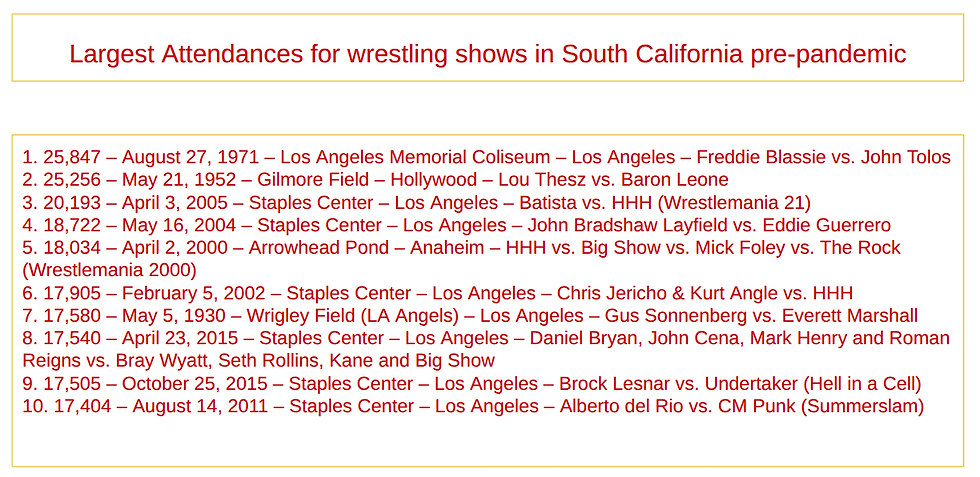
But Blassie’s love affair with the SoCal territory ended after his greatest triumph…
Walton noted that the idea for the match at the Coliseum and basics of the feud were put together 18 months ahead of time. Blassie picked Tolos, because he felt the program needed a great talker and he considered Tolos his equal on promos. The match drew a $142,158 gate, the biggest in American wrestling history up to that point in time. But both Blassie and Tolos, who were paid the same, were furious about their cut of the gate.
Blassie was so mad he took a gig with the WWWF to oppose the champion Pedro Morales in MSG. While he came back on-and-off for the next two years and drew well, particularly in rematches with Tolos, it was never the same. He jumped at the chance when Vince McMahon Sr., in late 1973, offered him a spot as a full-time manager, and moved to Hartsdale, NY, where he lived the last 29 years of his life.
While best known for his numerous sellouts in Los Angeles at the Olympic Auditorium, his track record in Madison Square Garden as a draw was also excellent.
His first main event ever in the building was July 11, 1964, where he headlined and beat Sammartino via DQ, drawing a reported 18,981. It was his third match ever in the building and first in ten years, as it was his fame as WWA champion (he had dropped the title by this time but was the man who popularized the belt) that made him an instant draw. A rematch three weeks later, with Sammartino winning, drew another sellout.
When he returned to the Northeast in 1971, he was billed as the Pacific Coast champion, and was known well by all the New York fans as a great babyface from the Wednesday night matches from the Olympic Auditorium that aired in New York on a two-week tape delay, so it was shocking to those people that Blassie, who used to wear a sombrero and a serape as a babyface in Los Angeles, frequently teaming with the likes of Mil Mascaras and Ray Mendoza, and was a hero to the Mexican fans, came in as a race-baiting heel to oppose WWWF champion Pedro Morales.
Like with his matches with Sammartino in 1964, this was the equivalent of the ultimate interpromotional dream match to many, thanks to Freddie’s success on the west coast. His promos on Morales leading to his November 15, 1971 match not only sold the building out, with 22,089 announced (but that’s a fake number as the building only held just under 20,000), but also with many turned-away fans, the most in the three-year Morales reign as champ.

Blassie was long past his physical prime and was never a great worker inside the ring, but was still awesome at facial expressions and body-language mannerisms. But he was just months past his career highlight, setting the country’s all-time gate record from the Coliseum match with Tolos.
Morales, who always got his hand raised in MSG for fear of a riot if he lost, won the first match due to blood. The rematch, on December 6, 1971, was billed as the first ever Roman Gladiator match in New York. Rules were no different from the usual Texas death match rules, but the name had a nice ring to it. Morales won in 7:14.
Blassie was brought back for a return shot on March 26, 1973, drawing another sellout, but again losing to Pedro due to blood in just 8:30 in an unimpressive match, as his knee problems from nearly four decades in the ring had now fully caught up to him.
His final MSG main event came after he had retired as a wrestler. He teamed with Nikolai Volkoff, his first protege, when he became a manager at the end of 1973, losing to Sammartino & Chief Jay Strongbow, before another sellout on June 24, 1974, making him 6 for 6 when it comes to main-event matches and sellouts in MSG. No other heel in history, particularly one who spanned two very different eras, can boast that "perfect" word in the world’s most famous pro-wrestling arena.
But his knees were bothering him again. They did a TV angle where Killer Kowalski injured his knee at the KCOP studios in Hollywood, the same place where they had done the Tolos powder angle less than a year earlier, on February 12.
Blassie was needing more knee surgery by that point. He actually came back in two months to wrestle in Hawaii, before beating Kowalski in a grudge match on June 16, but mainly wrestled in Hawaii and Japan for the rest of the year.
When he returned at the end of the year they revived the Blassie vs. Destroyer feud, and made it a hot issue quickly, but also faltered just as quick, as Blassie went back again to the WWWF. Tolos had since turned babyface by announcing that he had settled out of court for a huge amount of money in a personal injury lawsuit filed by Blassie for the eye injury. Blassie had forgiven him, so the fans could too. But unlike Blassie, Tolos wasn’t nearly as effective as a babyface, going back heel after losing a hair vs. hair match with Victor Rivera. After his head was shaved, he went nuts, doing the most violent beatdown angle that had ever been seen at that time, and then was renamed “Maniac” Tolos.”
Blassie was brought back to LA, winning a non-title match over Tolos, but losing the rematch when the title was at stake on September 21. He left for his final Japanese tour as a headliner, losing on DQ for biting nearly every night of the tour. He vacationed once again in Hawaii after the tour (as did a lot of wrestlers at the time) and on November 28, put over North American champion Billy Robinson in two straight falls in less than 8:00.
A superstar like Blassie would never lose in straight falls, and word got around that he physically knew he was done. Time was also against him, as in February of 1974, he’d turn 56, and the California State Athletic Commission would no longer allow him to wrestle. His knees were totally shot and his hips were going too.
He returned to Los Angeles after the Honolulu loss, building up to a loser-leaves-town match with Tolos. Before the match took place, he was already in New York as a manager for Volkoff to build up for a match with new champion Sammartino. After losing what was the last proper match of the career of “The Great Freddie Blassie," he was (supposedly) kicked out of the town he had once built. But he still came back about once a year for the next seven years, usually when Tolos would call him on the phone when he was headlining and nothing was going on and they both thought they could rekindle one more last time what was considered one of the greatest feuds wrestling had ever seen. They would limp along like that until 1980 with Blassie beating Tolos in his final match ever as a full-time wrestler for the LeBell promotion when he was 62 years old, in a very bad match with almost no fans in the building.
Both Vincent McMahon’s (father middle initial "J" and son middle initial "K") loved Blassie, both as a performer and as a character. When the elder Vince turned the business over to his son, one of the people it was understood that Vince the younger had to always take care of was Blassie, and Blassie was part of WWF television until he physically couldn’t be.
Blassie has always claimed credit for inspiring the man who used wrestling promos to become a bigger sports star than almost anyone in history, Muhammad Ali. But the truth is a little more complicated. Ali had mentioned in many interviews that he got the idea for trash talking his opponents and building up interest in his match with pro-wrestling style "heel" antics when he heard a pro wrestler's radio interview building up interest in a wrestling show in Las Vegas in 1961. Ali always identified that wrestler as the famed effeminate blond ring villain "Gorgeous" George Wagner.

This didn’t stop Blassie getting on the Ali train. In 1976, Ali was hooked up with Blassie and they met for the first time, largely for Blassie to help do publicity in wrestling circles for Ali’s match with Japanese wrestling legend Antonio Inoki. Blassie was the perfect wrestling spokesman because he was still one of the best interviews in his role as manager for the main-event heels. He had a huge name in the key markets like Los Angeles, Atlanta and New York, and was even more famous in Japan from his time there in the early 60s.
Blassie and Ali talked about the promos and the time frame, and noted that Ali’s promos were more like Blassie’s than George’s. Blassie claimed that Ali realized that it was he who Ali had confused with George, since both were among the few wrestlers to do the big-time blond dye job in those days. However, Blassie hated that after the Inoki match, when Ali would be asked where he learned how to do interviews, he would still say he copied Gorgeous George.
Freddie also had a longstanding friendship with Regis Philbin, the morning-show presenter and the host of the American version of Who Wants To Be A Millionaire, a relationship dating back more than 40 years. This was one of the reasons Philbin had always been friendly with WWF and had wrestlers regularly on his morning show, even though former co-host Kathy Lee Gifford was publicly negative to that, particularly after Rick Rude made an embarrassing appearance on a show in the late 80s (the words "sexual harassment" come to mind).
In Philbin’s opening monologue the day after Blassie’s death, he talked about his old friend, showing an early 60s photo of Blassie, Ernie Ladd, Destroyer and Jules Strongbow.
Blassie was not a big man, at 5, 8 legitimately (but billed at 5, 10) and about 230 pounds, he was smaller than not only most of the headliners he opposed, but also most of the TV stars he’d have photos taken with on the golf course and the big Hollywood parties he appeared at during his WWA World title run. On top of his smaller stature he wasn't a great athletic wrestler, either. With the bleached blond hair always in place, and the distinctive look with the bronzed tan (on Philbin’s shows, he would almost brag about his tanning, noting he’d get skin cancer all the time, and they would routinely be cutting parts of his body off but he didn’t care), he had the look and presence of a star, and understood the psychology and facials to work an audience. But it was the promos as “The King of Men,” bragging about his looks, his conquests in the bedroom and his wrestling ability, in rapid fashion, never pausing to take a breath, that made him one of the five biggest drawing cards of his era.

In the 80s, after being taken off the road in his role of being a manager due to his knees and hips being so bad, he worked in the WWF office, largely calling radio stations in the markets the company had live events in, and billing himself as the company’s official prognosticator, as he’d publicize the shows and make predictions. He was held in such high esteem, that over the past few years, he had been included in several videos, including pieces during the Attitude Era that showed the legends of the Vince Sr. era talking about the abilities of the modern crop of stars, endorsing them, where he sat in the balcony and portrayed himself as a fan of the new crop of wrestlers. He was also brought back for the early days of the " WCW Invasion" story, in a wheelchair, as, at the age of 83, he gave a stirring pep talk to the WWF wrestlers on a RAW episode which led to Steve Austin saving the day for Team WWF on the go-home show for the Invasion PPV, (Austin would then betray his team 6 days later) in what would prove to be Blassie's final classic interview.
His last appearance on WWF/E television was on an episode of RAW in 2003. He portrayed a feisty old man, full of rambunctious spirits even while confined to a wheelchair, and when asked his age by Eric Bischoff, he replied, “29.” There was big hope for the in-ring segment getting over which 3 Minute Warning (Rosey and Jamal) would threaten to beat up the helpless legend, but he was saved by the Dudleys, and Freddie would say the Dudley catchphrase, “D-Von, get the table.” But there was something uncomfortable about seeing Blassie in that bad shape, and the segment was better looking in the script than it turned out to be.
Blassie’s remaining kidney got a bacterial infection right after the appearance, and he was hospitalized a week later, forcing cancellation of a lot of radio appearances scheduled to promote his book. Freddie would pass exactly 3 weeks after that RAW appearance. Later that night, on the live airing of RAW, Jim Ross would break the news of Blassie’s death.
Freddie Blassie was the template of a heel. Dare I say it, there are molds of Blassie in MJF (I’ve just lost the argument for Blassie’s inclusion with some friends, I think). Blassie was one of the great draws of an age where the big cities were becoming the big territories of wrestling and no man was a bigger draw in the biggest cities on both the west and east coast of the USA. Blassie was an original.
G.O.A.T. 100 Portal
Links to all GOAT100 profiles published so far
G.O.A.T. 100 Image Grid



Comments