.png)


The G.O.A.T. 100 #72 | Jun Akiyama

Welcome to the G.O.A.T. 100 where we will count down with PWM wrestling historian Peter Edge the 100 greatest wrestlers of all time, based on many different stats and criteria. A new wrestler will be added on Mondays and Thursdays every week. Here is a link to an introduction essay with Peter explaining his GOAT100 concept. At the bottom of the article you can find the GOAT 100 Portal with links to all profiles so far published, as well as a visual key... Enjoy learning more about the history of our great hobby!


When you think of All Japan Pro Wrestling, the “Four Pillars” come to mind. But in Japan in that era, the term “Four Kings” was just as widely used by the puro aficionados. But if Misawa, Kobashi, Kawada and Taue can be comparable to English Kings such as Edward or Richard the First, then Akiyama is George VI – presiding over the crumbling of an empire.
Born in the city of Izumi, Jun would be part of the wrestling team at Senshu University that has a legacy with pro wrestling that is linked by Riki Choshu and Hiroshi Hase. He also excelled in swimming as a teenager and was so good for the age range that if he progressed as expected, that he could have represented Japan in international competition in aquatics. Jun was scouted by AJPW and trained at their dojo, making his debut in September 1992 in a losing effort against Kenta Kobashi on the 20th Anniversary show.
It was obvious that Akiyama was seen as a potential future superstar. His introduction to the AJPW audience was unprecedented. Jun was still at university when introduced to the media at a press conference alongside AJPW owner Giant Baba, and he was introduced to the crowd on an All Japan card on 1992.3.15, months before that debut match against Kobashi. He was positioned as the best thing since Jumbo Tsuruta, who had been similarly plucked out of amateur wrestling by Baba at the time of the formation of All Japan in 1972. The Kobashi debut has been called the greatest debut match by many, and justifiably so in my opinion.

Initially put with Jumbo’s Tsuruta-gun faction, and after that with the Holy Demon Army faction, (people always think this is the name of the Kawada/Taue team but actually is the name of the faction they led) Akiyama won the Rookie of the Year Award in the 1993 Observer Awards, even in a year when his best matches were multi-man tags – Jun’s first “notebook” singles match being in March 1995 again facing Kobashi.

People have said that Jun Akiyama is one of the best rookies in wrestling history but his progression was slow going because of Baba’s style of booking, with Jun not even going on an excursion like many before him thanks to a growing isolationism in Baba’s attitude regarding the business.
As 1995 started, Akiyama split with with HDA and started to team with Takao Omori winning the All Asia Tag Titles (the secondary tag titles in All Japan) together, holding onto them for 1,076 days with 14 defences before losing them to Wolf Hawkfield and Johnny Smith – but out of those 14 defences, none featured any of the Pillars.
But, while still defending the All Asia titles with Omori, Akiyama began to also tag with Mitsuharu Misawa starting in January 1996 (after Misawa and Kenta Kobashi split up so they could embark on their legendary series of matches in the latter half of the 90s.) Misawa and Akiyama would have two five-star matches teaming against Taue and Kawada, those matches taking both #1 & #2 in my MOTY list for 1996. Their match on the World Strongest Tag Determination League is first on my list and would win the Observer MOTY Award, but their 96.5.23 match deserves a lot more recognition than it gets.

The pair of teams would be the final match of the Tag league in 1997, but the Holy Demon Army would once again win the match to lift the trophy.
Akiyama would switch allegiances, teaming with Kobashi to form the Burning faction. The pair would win the tag titles twice, winning the 1998 and 1999 Strongest Tag Determination League. Akiyama through his partnerships with Kenta and Mitsuharu has placings in my Tag Team of the Year lists in the all last four years of the 90s, taking #1 team in 1996 and 1999 with Misawa and Kobashi respectively.
While Akiyama’s time in AJPW was best known for his tag work, he did have four matches for the Triple Crown, falling short each time to become champ. Two of these challenges were placed Top 5 in my 1998 MOTY list, one against Misawa in January 1998 and then Kobashi in July. Puroreso dominated in-ring in a year that was more focused on stories than action in the states, whereas the action was strong but business had stagnated for Baba’s circuit.
Until Akiyama got his first shot at the belt in late ‘97 the last Japanese wrestler to be involved in a Triple Crown Championship match besides the Four Pillars was Jumbo Tsuruta back in January 1992, and the only challenge by “gaijin” in that time besides Stan Hansen and Steve Williams was one shot by Gary Albright in March 1996. In all, Akiyama was just the 12th different person to contend for All Japan’s most prestigious crown in the 90s. Compare that to 24 that would be in an IWGP Heavyweight Title match by the time Akiyama vs Misawa for the TC would happen.
Akiyama would finally get to beat one of the Pillars in Q1 of 2000 with a victory over Misawa on 2000.2.27, but within months Jun was part of the exodus away from AJPW following the post-Baba president Misawa to start a new promotion together after he fell out with Baba’s widow Motoka. The first show that Pro Wrestling NOAH (the company set up by the exiles from the house Baba built) put on had one goal – to make Jun Akiyama a star.
Like many others that made the big jump – the biggest change in the puro landscape since the splits that led to the founding of NJPW and AJPW almost 30 years before – Akiyama made a change in his own visual presentation. The blue trunks that were synonymous with him for the last 8 years were now pure white, with the blue trim gone from his white boots as well. Dressing all in white didn’t mean the attitude he had was of a good guy, though.
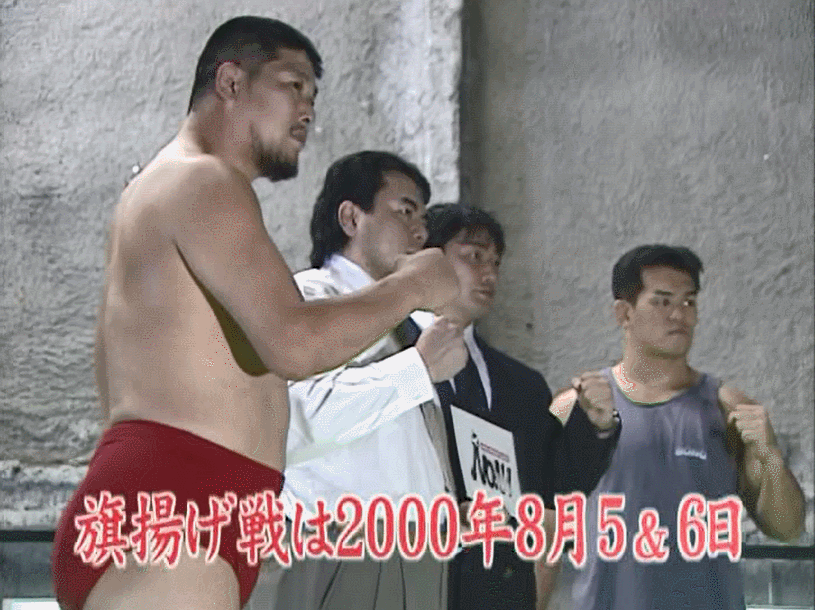
The main event of the Departure show saw Akiyama teaming with his Burning partner, Kobashi to face Misawa and Taue in a 2 out of 3 Falls, with Akiyama pinning both Misawa and Taue in two straight falls. After the match Akiyama hit his Exploder Suplex finisher on Kobashi and walked straight out of the ring and down the elevated ramp. It was ostensibly a heel turn but the fans in attendance weren’t having that. Knowing they were finally getting to see a push for someone outside the established kings of All Japan, they cheered Akiyama regardless.
The next night Akiyama cemented his position as a main eventer by choking out Kobashi in singles. Kobashi might have got his win back in a match that ended the year for NOAH in 2000, but the plans were clear for the 21st century, that – in booker Mitsuharu Misawa’s mind at least – Akiyama would lead the charge for the first part of it.
Akiyama went on to lose in the semi-final of the tournament to crown the first GHC World Heavyweight Champion against Mitsuharu Misawa in a match that – after a double count-out saw a restart which went less than two minutes and was way more exhilarating than the 13 minutes of the “first fall” – ended with a great finish. But the 6.85 on Cagematch and my personal rating of 3.75 say that the pair had plenty left in the tank for future matches.
The rematch for the GHC belt that Misawa went on in that tournament to win against Yoshihiro Takayama would be the crowning for Akiyama. He won his first World Title, but in-ring it could have been better. I like the Misawa / Takayama match three months earlier better than his title victory, and better than any of the defences of Akiyama’s first major title reign, either. None of the matches when Jun defended the GHC belt (against Tamon Honda, Vader, Yuji Nagata and Yoshinari Ogawa) would go above 4 stars.
The Nagata defence is unique in that it was the first time the main title from a rival puro company was defended on NJPW’s annual 1.4 show at the Tokyo Dome and it main-evented that show in 2002 in a battle of the Exploder Suplex.

In the most Inoki-ism of Inoki-ism things, the Akiyama vs Nagata match would be five days after Nagata faced Mirko Cro-Cop. Yes, that Mirko Cro-Cop – the MMA fighter who was legit great at this time. Nagata lost in less than a minute.
Akiyama’s reign with the GHC Title would end in less than five minutes against Ogawa. The 4:20 length of match was to begin to train the audience that the end of a big match could come at any time and not every Heavyweight Title match they were going to watch would be the 30-minute epic that they had learned to expect in the decade past.
The average run time of the next 10 GHC Heavyweight Title matches would be 23:57.
Akiyama would win the GHC Tag Titles with Akitoshi Saito later in 2002, a reign that lasted 256 days before Kobashi and Honda beat them at the June Nippoon Budokan show that was traditionally one of the big shows on the puroresu calendar.
Akiyama would unveil the GHC Openweight Hardcore Championship in March 2004 but this wasn’t a case of “what it says on the tin” – with its title matches having a 15-minute time limit, the USP of the belt was more akin to the Television Title in the days of Jim Crockett Promotions and early 90s WCW instead of the division in WWE that saw classics like Hardcore Holly vs Al Snow.
(Shame, because I’d love to have seen Jun Akiyama and Mitsuharu Misawa doing a match at an amusement arcade like Crash Holly and the Headbangers did in 2000.)
Jun would hold that belt for 7 months before losing the title to Noamichi Marufuji, but in that period where he was Hardcore champ, he also got a chance to win the Heavyweight title on the biggest stage NOAH would have in their so-far four-year existence.

NOAH was the No.1 company in Japan as 2004 developed. NOAH’s year-end financial records for the business year were better than New Japan’s – seeing them with 1.58 billion yen ($13.4 million) to New Japan’s 1.36 billion yen ($11.5 million).
NOAH were bullish enough from this position to attempt to put on a show at the Tokyo Dome and the main event for the show would be Kenta Kobashi defending the GHC Heavyweight belt against Akiyama. The match would be Tokyo Sports’ MOTY, the highest-rated match of 2004 on Cagematch, and it won MOTY in the Observer Awards for that year. (Oh, and most importantly, got 5 stars from me and is my MOTY for 2004.)
The most important thing in NOAH’s eyes would be the 58,000 attendance for the night (that was the number reported) which is the second-highest Dome attendance from that night onwards with the next year’s NOAH Dome show’s 62,000 being the only draw to top that night in July 2004.

The July 2005 show would see a dream match between Kobashi and Kensuke Sasaki and a renewal of the Mitsuharu Misawa vs. Toshiaki Kawada rivalry as the top two matches. Jun Akiyama would be part of the GHC Tag Title match, coming up short when challenging for the belts with Makoto Hashi, his protege against Minoru Suzuki and Naomichi Marufuji.
The teacher/student relationship with Hashi made up the majority of his 2005 in NOAH with Akiyama playing the dickhead teacher showing “tough love” to Hashi.
The first month of 2006 saw Akiyama beat Akira Taue to start his second reign with the GHC Heavyweight belt. This reign would fare better than his first when it came to match quality, with barn burners against Minoru Suzuki and Masou Inoue before losing the belt to Marufuji at Budokan in September – which didn’t burn any barns, a trait more often than not seen in matches between graduates from the junior heavyweights and the established kings of the heavyweights in NOAH.
Post-title loss, Jun went through a storyline that saw him build his confidence up after the soul-crushing loss to Marufuji with Akiyama wrestling in his original blue tights until he felt worthy of being in white tights, something that happened when he beat his AJPW senpai Tsuyoshi Kikuchi. Not long after, Jun would win the tag belts with Takeshi Rikio, but due to a Rikio injury, the titles were stripped. Then in March 2009, Akiyama beat Sasaki to win the GHC heavyweight for the third time. But at the same time business for NOAH was dwindling, Akiyama’s luck completely vanished with a lumbar disc herniation leading him to vacate the title. Just a month later, the company that Akiyama had helped form would be struck its harshest blow ever when founder and president Mitsuharu Misawa died in the ring at a show at Hiroshima.
Akiyama would go into depression after the death of one of his contemporaries, with an ongoing back problem also contributing to his mental health problems. The company would see its downhill slide worsen from the struggles it was enduring in the years before Misawa’s passing after the global financial crisis hit the yen badly.
NOAH had already lost its TV deal with Nippon TV as Nippon made cuts due to the recession, but the struggles increased after Misawa’s death. But instead of going back to the old heads like Misawa would do in times of trouble (when he would book himself, Kensuke Sasaki or Jun Akiyama to go on top) a new booking committee that included Akiyama looked to the younger generation of the roster to hold the GHC Title in Misawa’s protege Go Shiozaki and Takeshi Sugiura. Unfortunately, neither man turned out to be the talisman for NOAH that Hiroshi Tanahashi was proving to be for NJPW in this period.

Akiyama’s success would be in tournaments as those young guns were heading up the main event scene. The first ever annual Global League, which would become the N-1 League, in 2010 would see Jun get to the final but lose to Yoshihiro Takayama. The 2011 Global Tag League, in its fourth edition, would be won by Akiyama and Akitoshi Saito – the very man who executed the backdrop suplex that was the literal straw that broke the legends back in the tragic accident that ended Misawa’s life.
NOAH would be working with AJPW as both were trying to get back to former greatness and on 2011.10.23, Jun would win the Triple Crown Title beating Suwama and accompanied the championship win with a new look – a shaven head that he would keep for the rest of his career.
The reign would last 10 months before Masakatsu Funaki beat Akiyama to win the title in a match that lasted less than 5 minutes, just like how Jun lost his first GHC title a decade previous.
Akiyama and Saito would win the GHC Tag Titles for the second time beating Karl Anderson and Giant Bernard whilst he had the Triple Crown belts – but his time in NOAH was approaching an end.
With less than a month left of his NOAH contract, which ended as the year turned to 2013, Akiyama had yet to renew and negotiations had fallen apart with Jun going public with his dissatisfaction, threatening to not re-sign. This statement came after NOAH released Kenta Kobashi from his contract and then NOAH confirmed that Akiyama would be leaving when his contract expired with Jun’s final appearance on Christmas Eve with Jun wrestling as “Mr. Christmas” on his final night in the company.
Jun wasn’t the only person leaving as Shiozaki, Atsushi Aoki, Kotaro Suzuki and Yoshinobu Kanemaru were part of an exodus moving from NOAH to AJPW, and upon appearing in an All Japan ring formed a new Burning faction in tribute to the top group in the company in the late 90s.
Title success in All Japan came in World Tag titles with four reigns – three of them being with Takao Omori – plus three DDT Ironman Heavy Metal reigns, a title which was a “24/7 title” like the WWF Hardcore Title and like the 24/7 Title that was part of WWE television in the late 2010s and early 20s. To little surprise, DDT did this concept better than the Fed in that latter version, anyhow.
Appearances in the Champion Carnival and Triple Crown Championship matches saw crackers against Naomichi Marufuji and Kento Miyahara with the second reign Jun would have with the Triple Crown belt going from November 2015 and his victory over Akebono to the second day of 2016 – more-or-less a transitional title reign with Suwama taking the title from Akiyama.
Akiyama would start appearing in DDT during 2020 and would be in an elder statesman role. He would win the D-Oh Tournament (no, it’s not a tribute to Homer Simpson) in the final months of the annus horribilus for Planet Earth, beating Konosuke Takeshita in the final – with the KO-D Title match against Tetsuya Endo seeing Akiyama win the KO-D Openweight Title (the main title in the company) in a great match. The now 51-year-old would be champ for 188 days, having blistering matches against Kazusada Higuchi, Danshoku Dino and HARASHIMA at the CyberFight Festival show that showcased the companies in the Cyberfight stable that NJPW had just joined after the company was purchased from Bushiroad.

At Wrestle Peter Pan 2021, Konosuke Takeshita hooked the belt from Akiyama to start his fifth reign with the title but even though he wouldn’t get a shot at the main title for 5 years after, Jun was still executing quality matches with the likes of Kazusada Higuchi, Teysuya Endo and Yuji Hino producing quality matches with the 50 year-old+ legend being very giving to the younger generation
Why is everyone staring at Adam Copeland right now?
One of the great aspects of AEW is seeing things that you thought you’d never see on American Wrestling television – and Jun Akiyama doing what none of the Four Pillars would do and working for a major company in the USA fits that mould of surprises. He did three matches for All Elite Wrestling, teaming with Takeshita when Takeshita was in his great-wrestler-losing-matches era to face Eddie Kingston and Ortiz, and then making Kingston’s boyhood dream came true the next day when he faced Jun Akiyama on the pre-show for the Full Gear show. Then 15 months later, Jun would face Bryan Danielson on an episode of Collision. All three were ***¾ matches.

Jun Akiyama is a case of what happens when someone doesn’t pull the trigger on someone when it could be time and he’s also a case of what happens when you finally pull the trigger on someone and it maybe isn’t what you thought it would be.
Akiyama is one of the most natural, talented wrestlers to ever step into a ring, but he didn't have the connection that Kobashi had with his audience, he wasn’t the bastard that Kawada was on-screen, and he didn’t have the insane level of talent Misawa did – as undeniably good as Jun was.
Akiyama was never a pillar when it came to the promotion he worked in his prime but he was … the back lawn. It doesn't hold up your house, but it's pretty to look at, and if you treat it right it can be around for a while, and it needs rainy days to look its best…
(God, I could do with one of those right now.)
Jun is revered by those who work today that took an interest in the puro scene in the 90s and 00s. He is quite simply a wrestlers’ wrestler and it’s hard to find a bad Akiyama singles match. In fact there’s only 4 on Cagematch with a rating under 6.00 and one of those is “the greatest debut match of all time” against Kobashi with the other three being a Mohammed Yone match in 2007 and two DDT matches against Akito and Rukiya in 2023 and 2026. That level of consistency tells you just how fucking good Jun Akiyama is.
G.O.A.T. 100 Portal
Links to all GOAT100 profiles published so far
G.O.A.T. 100 Image Grid


Comments