.png)


The G.O.A.T. 100 #95 | Bobo Brazil

Updated: May 24
Welcome to the G.O.A.T. 100 where we will count down with PWM wrestling historian Peter Edge the 100 greatest wrestlers of all time, based on many different stats and criteria. A new wrestler will be added on Mondays and Thursdays every week. Here is a link to an introduction essay with Peter explaining his GOAT100 concept. At the bottom of the article you can find the GOAT 100 Portal with links to all profiles so far published, as well as a visual key... Enjoy learning more about the history of our great hobby!


Ok, let's talk about the elephant in the room. There are not enough black wrestlers on this list. In all, there will be three… and without posting spoilers, one of those wrestlers, as a friend of mine points out: “prefers the Samoan part of his heritage to his Black side”.
This is something that doesn't feel great on my end: it's not in line with the progressive mindset I have on life and on issues to do with equality. But on investigation as to why – this was something that was always going to happen.
.
North American wrestling has not treated Black wrestlers well, and the study of wrestling history hasn't done much better. The systemic racism from promoters was plain to see – it mirrored society, but was still inexcusable. Even the relatively open-minded were a mixed bag. One of the greatest promoters of Black talent of the time, Bill Watts used that 6-letter word beginning with "n" to describe Black people on a regular basis… and in a 1992 interview with Wade Keller, he still openly backed bringing back segregation in restaurants. But he was also the architect of the megapush of The Junkyard Dog in Mid-South, and was the man who booked Ron Simmons to win the WCW World Title. And Vince McMahon, the man in charge of the “worldwide leader in sports entertainment," had a mindset towards minorities that is troublesome – which might be an understatement.
But the racism that limited their opportunities at the time wasn't the only factor that hurts the recognition of old-school Black wrestlers today… In the episode of The Gentlemen’s Wrestling Podcast where host Jesse Collings spoke to writer and wrestling historian Ian Douglass about the lack of Black wrestlers in the Observer Hall of Fame, Douglass points out that the regional stars of the era before television don't get the credit they should from WON voters because there isn't any footage to assess workrate and the voters don't always have the historical context to realize that a non-Heavyweight championship might have been the most important title in a given territory.
And that, while this effects wrestlers of all races, it effects the old-time Black wrestlers even more unfairly… so they aren’t properly acknowledged, even in the legacy / posthumous picks that Dave Meltzer makes specifically to highlight wrestlers that were at their height of their fame more than 60 years before.
The wrestler known as "Seelie Samara" rose to success in the mat game in the 1930s all around the country, especially in the New England area. "Rough" Rufus Jones (not Rufus R. Jones, the seventies star) was an important influence on future Black wrestlers, (even if it was originating negative tropes: the supposed "hard head") and also one of the top heels in the Midwest throughout the 1940s.
Jack Claybourne, from 1934 onwards, would be an important attraction in the territories where he appeared. In fact, he was the biggest star in Hawaii for a time, (and had significant success in Toronto as well) but promoters in the big cities dismissed it, internally calling the Hawaii Heavyweight Title while he held it as the “Negro Heavyweight Title” (not laudatory.) Claybourne would talk about television ruining the career of Black wrestlers because TV stations didn’t want to show the likes of himself or Jim Mitchell on their programming.

Yet while Big Daddy Siki is currently on the Observer HOF ballot, the above three aren’t, despite being direct influences on him.
Trivia note: only six Black wrestlers are in the Observer Hall of Fame.

Even modern-day Black media outlets that report on wrestling occasionally don't seem to want to celebrate its history makers, certainly in the case of BET:
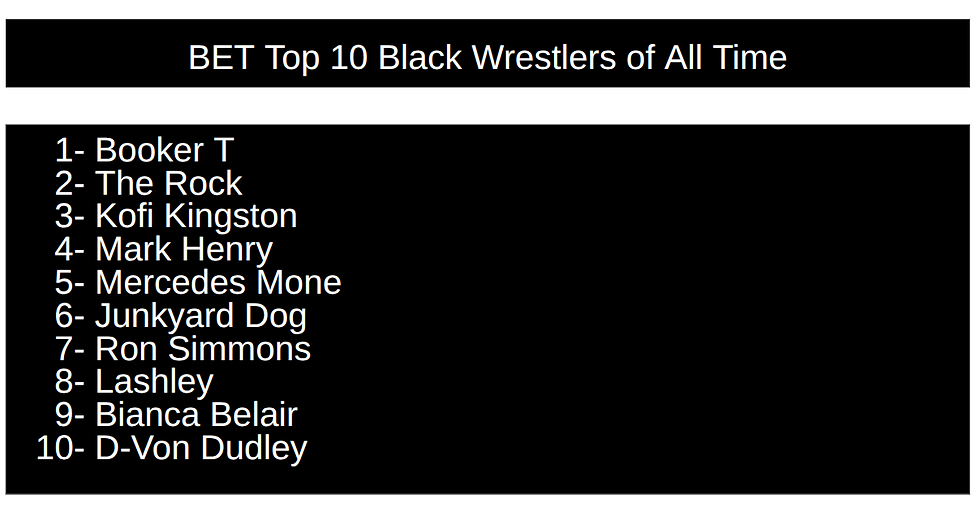
Holy fedpilled Batman.
And the above doesn't show Naomi finishing 12th and Jazz at 15th on the list. The fact Bobo Brazil and even Bearcat Wright – pioneers amongst Black wrestlers – aren’t in the Top 10 of this list says a lot about how they are ignored by the modern fan.
So what makes Bobo so special that he is in the G.O.A.T. 100?
Bobo was evidence that talent, dignity and charisma could break through the barriers that generations had fought so aggressively to maintain.
All the opportunities America ever had to have racial equality had been ignored. The presidents after Abraham Lincoln's assassination maintained the inequalities rather than fighting them. Some Commanders-in-Chief even embraced racism – with Woodrow Wilson having a showing of (notoriously racist "film masterpiece") Birth of a Nation at the White House.
And while MLB had Jackie Robinson, the NBA had Bill Russell, and Jesse Owens and Joe Louis would achieve feats that 99.99999999% of their peers couldn’t achieve, wrestling wouldn't start to break that racial barrier until the 60s.
During the 1950s and early 1960s, racial segregation was still common in professional wrestling. Many promoters would only book Black wrestlers against other Black wrestlers. Many arenas forced segregated seating. Some territories simply refused to book Black wrestlers at all.
Bobo Brazil changed that.
Born Houston Harris on July 10, 1924 in Little Rock, Arkansas, he grew up primarily in East St. Louis, Illinois, before later settling in Benton Harbor, Michigan. Houston’s early life was shaped by hardship, with his father dying when he was young, forcing Harris to help support his family through manual labor while still a child.
Harris was a gifted natural athlete and played baseball for the Black House of David team – an offshoot of the long-bearded Globetrotter-esque barnstorming team that represented the Michigan religious commune. Like many young Black athletes of his generation, baseball seemed like his most realistic path to a professional sports career.
But that path changed when he was discovered by wrestler and promoter Joe Savoldi, who immediately saw star potential in Harris’s massive 6’6”, 270-pound frame – combined with agility against the grain of people of that size then – and in his natural charisma. Savoldi personally trained Harris and helped launch him into professional wrestling.
Harris’s first recorded match was on March 29, 1948 under his government name, nicknamed "The Black Panther," fighting an Armand Myers. Later, Houston would be promoted as “BuBu Brasil, The South American Giant,” a persona that was designed to give promoters flexibility in booking him in racially segregated territories.
But wrestling history changed thanks to a simple mistake. A typographical error in promotional materials changed “BuBu” into “Bobo.” Rather than correct it, promoters leaned into it and the now-iconic name was born.
By the mid-1950s, Bobo Brazil was touring the territory system – working Canada, the Midwest, and the West Coast – quickly building a reputation as one of wrestling’s most exciting attractions, until settling in the Detroit region, the area where he was most loved by the fans as a local boy.
He should have won the World Title in 1962 when he pinned Buddy Rogers in a title match in Newark, NJ on October 18 after an unintentional kick to the groin felled the original “Nature Boy” causing a ref stoppage after Rogers was unable to continue to the second fall. Therefore under NWA rules, a title change should have happened – but Brazil turned down the title. Some promoters did acknowledge him as champ, but the NWA soon clarified that the champ to be recognised would still be Buddy.
Bobo also challenged Bruno Sammartino for his WWWF Title at the Philadelphia Spectrum in a very rare face vs. face match – but more commonly the pair would team up: 28 times in 1963 and 1964 during the early years of Bruno’s hold over MSG Arena.
(By the way, Bruno had also beat Buddy two weeks before Bobo did by the same manner. Coincidence in pro wrestling – surely not.)
But the feud that Brazil is best known for is with a Detroit wrestling stalwart like himself – The Sheik. In all, the pair were on the opposite side of the ring 185 times – 128 of those being 1 vs. 1 contests – wrestling in cities such as Buffalo and its NWA Upstate promotion, for the LeBell brothers in LA, and for the WWWF primarily in the Washington Coliseum – but it was in their home territory, Detroit-based Big Time Wrestling, where the pair fought the most, wrestling in Texas Death Matches, Lumberjack matches (that consistently ended in count-out finishes – look, it was The Sheik) and cage matches. The pair would wrestle a match against each other every year – bar 1963, 1964 and 1981 – in the 23-year period between 1961 and 1983.
Brazil had a way of talking that was separate from the usual mould of a babyface. In a low, quiet volume, he’d ask the fans to come out to support him, saying that he needed their support to have a chance of winning against the despicable Sheik, and pledging that he wouldn’t let them down.

Batman to Sheik’s Joker, Brazil was the man who The Sheik had the most sustained success with in his time as top dog of Big Time Wrestling, the Detroit territory that Ed Farhat – the man behind the Sheik character – owned. Using the usual Sheik feud formula for a series in the Motor City, with a trilogy of matches including a Texas Death Match and a Cage Match, they filled houses at the famed Cobo Arena – the Mecca of Big Time, the place where all the biggest matches took place.
According to The Sheik's biography by Brian R. Solomon, Brazil beat Sheik in a Texas Death Match to win the Detroit version of the United States Title at Cobo Arena to end Sheik’s over-2-year reign, giving some relief and hope to the people of Detroit, at a time when the city had just gone through the long, hot summer of 1967, the worst riot America had seen since the 1863 draft riots in New York City, six days of chaos of a scale that wouldn’t be matched until the 1992 L.A riots.
Of course, Sheik being Sheik, he had to book himself to regain the title, winning it back in a cage match six weeks later– but in Dayton to avoid provoking any unrest in Detroit over it. This brief reign is not listed in record books – possibly one of those only reported on in the local market.
The pair would also match up in L.A at the Olympic Auditorium for the LeBells' WWA during that promotion's final months as an outlaw promotion before they rejoined the NWA firm, with further matches in the late part of the decade in which Brazil lost the America's Heavyweight Title FKA as the WWA World Heavyweight Title in February 1969, a booking decision made so Sheik could feud with Freddie Blassie to facilitate Blassie’s babyface turn.
But elsewhere, in the first 17 months of the 70s, 10 United States (Detroit version) title matches between the pair would take place in three different cities, (Detroit, Toronto and its Maple Leaf Wrestling promotion and Buffalo and the NWF) with all the matches bar one ending in a DQ, count-out or no-contest.
But on May 29th, 1971, Brazil ended the longest of long title chases (seeming even longer to those outside the Detroit area who likely didn't know about the 1967 title change) by beating Sheik in a Texas Death Steel Cage Match in front of a sold out crowd at Cobo. Yes, the finish had Sheik more protected than an LA Laker in the early 00s – with Lord Athol Layton (one of Bobo’s partners in his eight reigns with the Detroit version of the NWA tag-team belts) as special guest referee, and a three count that would have made Nick Patrick go “slow down there, buddy” – but the jubilant scenes that came after showed that Bobo “finishing his story” was arguably the most important moment in the history of Detroit wrestling.
That night Bobo would end Sheik’s 2289 day reign, (with a 14-day break thanks to that perennial title winner Vacant, according to Cagematch, not to mention – according to Solomon's book – that six-week break to Bobo in 1967 we just talked about, unacknowledged outside Big Time) and would hold the belt for 441 days, part of an almost year-and-a-half hiatus that saw the Sheik without the US Title (Detroit version) – the longest he ever went without it. And Brazil's reign with that title was the longest of anyone who wasn’t The Sheik. In all, Bobo had eight reigns with the Detroit United States title with six of the eight being ended by either Sheik or Pampero Firpo.
Brazil’s lengthy reign with the US Title came just as Dick The Bruiser and Wilbur Snyder were looking to expand their Indiana circuit into Detroit, sparking one of the biggest promotional wars in the territorial era before the National Expansion. His run would be one of the main weapons in his promoter’s and IRL friend’s mission to ward off the invasion – with feuds against Bill Curry, Ernie Ladd and Dingo the Sundowner helping to increase business at Cobo despite the newcomers in town.
The Brazil / Sheik feud was trusted enough to be a box-office hit that it was on the card to help draw the record-setting crowds to the 1971 Memorial Coliseum spectacular in Los Angeles. Before the famed Monsel’s powder angle that ignited the Blassie / Tolos rivalry that would headline the show (at the same stadium that went on to host the track and field program at the 1984 Olympics and will again at the 2028 L.A. Olympics) it was Brazil and Sheik who were trusted to persuade fans to buy tickets for the show. To the surprise of no-one, there would be no clean result in the match – with a no-contest at the end.
Bobo would be one of the eight legends that Giant Baba had to go through to become the inaugural PWF World Heavyweight Champion, being the final hurdle that Baba had to clear to win the belt. This was the first Japanese tour that Bobo went on, and he made enough of an impact that he went on eight more.

The first year of the seventies saw Bobo achieve another milestone, competing in the first racially-mixed wrestling match in Atlanta, teaming with El Mongol against Mr. Ito and The Great Ota – a full 10 years after Bobo was part of the first non-segregated match in Indiana. Despite Bobo’s popularity with fans, the barriers he would encounter outside the ring showed what America was like even after President Lyndon B. Johnson passed the Civil Rights Act in 1964. Killer Kowalski would talk of the same fan who had cheered Bobo in the stands refusing to let him rent a room in the hotel they worked at, with Bobo having to sneak into Kowalski’s room to have a roof over his head for the night – and that night wasn't just a one-off.
Bobo would remain a fixture of American wrestling into the 80s. He became a mentor to young Black wrestlers such as Rocky Johnson and he would train James “Kamala” Harris. He would wrap up his feud with The Sheik with a series of matches in Big Bear Promotions out of Ontario – with Bobo not getting a single win in the three matches.
In all, in their 128 matches, Brazil beat Sheik clean in 19 of them – the highest anyone can claim against a man who might have been patient zero for the back injury that means you cannot keep your shoulderblades on a wrestling mat for 3 seconds. (Yes, I'm looking at you Alastair / Malakai Black!)
Florida, the AWA, Indiana and the WWF were the usual stops for Bobo as he was winding it down – with Bobo going part-time before spending 1984 in New York where he was involved in the feud with his protege Johnson and his tag partner Tony Atlas against the trio of Roddy Piper, David Schultz and Bob Orton – the most pushed heel act in the first year of Vince-ism with a Piper / Hogan feud in mind.

His son Karl would follow his father’s footsteps into wrestling, but had limited success – with his biggest platform being in World Class in its final years, and in FMW under the name Calypso Jim, only taking the diminutive of his father’s stage name in 1994. In Pro Wrestling USA – the failed attempt to form an alliance to take down the Death Star (WWF) – we saw the only time on record that Bobo teamed with Bobo Jr. in a match against the Irwin brothers in Fort Wayne, Indiana.
After suffering a series of strokes, Bobo Brazil would pass away at the age of 73 at the Lakeland Medical Center in St. Joseph, Michigan on January 20th, 1998.
When researching this bio, I came across a YouTube video called "Bobo Brazil: The Most Forgotten Wrestler." People in the comments said that they actually never forgot him. If you were in those arenas in his haunts of Detroit, Buffalo and Toronto and saw the magnetic presence that he had and the connection he had with the masses, Bobo could never have been forgotten.
He certainly wasn’t forgotten by those with decision-making power in the 90s when he was inducted into the WWF Hall of Fame in 1994 – in what was just the second class of Vince McMahon’s hand-picked recognition groups (this might have been also because Bobo was one of the very few of the stars that worked for Vince Sr. that hadn’t burned bridges with Vince Jr.) Bobo was also in the inaugural class of the Wrestling Observer Hall of Fame in 1996 that Dave Meltzer hand-picked, one of 100 to be on that list for their in-ring qualities.

But in a world where wrestling history is rewritten by a certain wrestling company with a narrative that they saved the art of wrestling, (an art they love so much that they insist on calling it sports entertainment) Bobo in the 21st century is a name that doesn’t get talked about as much. Bobo was one of the harder names from the United States to research for the G.O.A.T. 100 but when you learn his story it’s clear that it's important that we know it.
I once wrote that The Junkyard Dog walked so the current generation of African-American wrestlers can run, but actually it was Bobo that ran that all-important first leg of the relay, to pass the baton to Swerve Strickland and others who continue running that race today.
G.O.A.T. 100 Portal
Links to all GOAT100 profiles published so far
G.O.A.T. 100 Image Grid


Comments