.png)


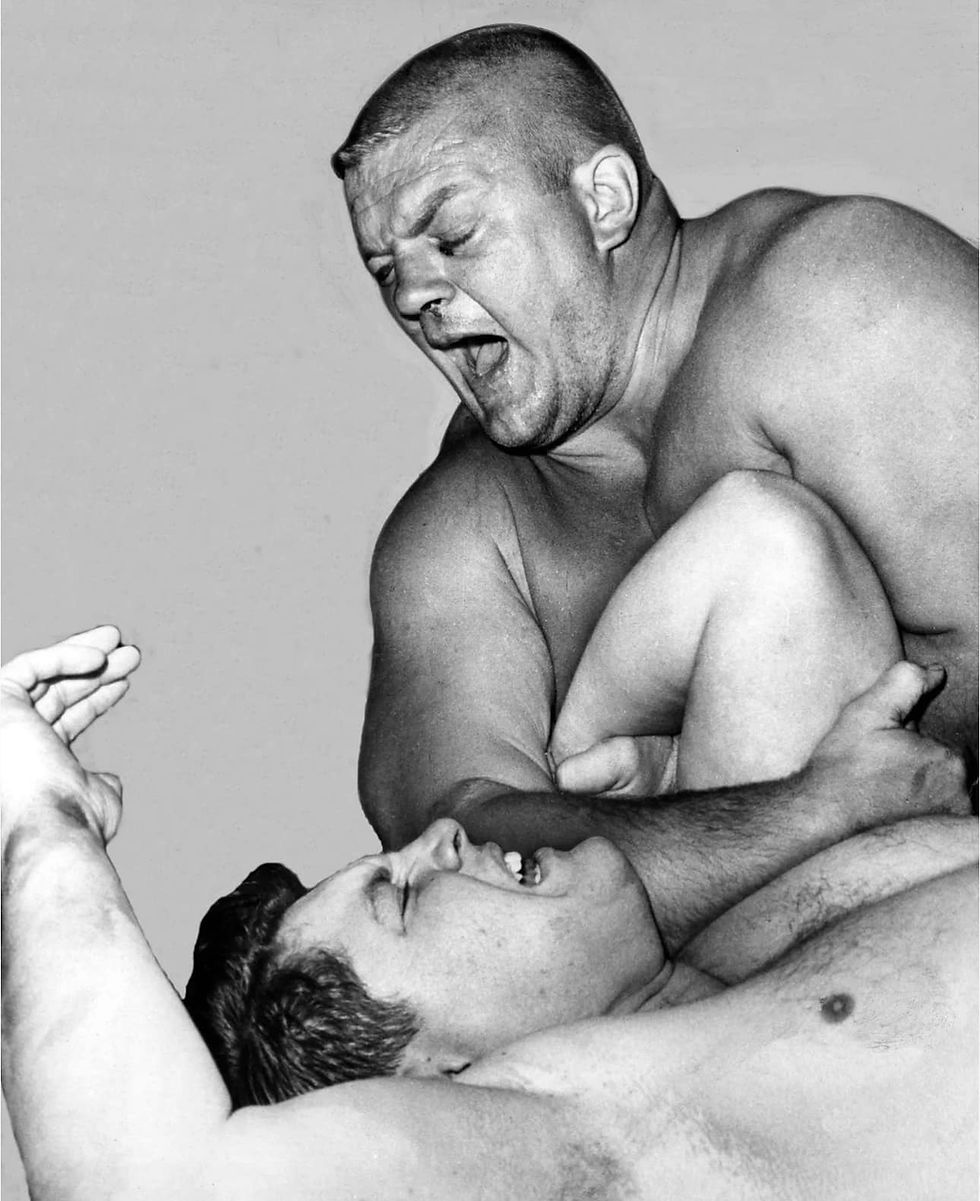
The G.O.A.T. 100 #90 & 91 | Bruiser & Crusher

Welcome to the G.O.A.T. 100 where we will count down with PWM wrestling historian Peter Edge the 100 greatest wrestlers of all time, based on many different stats and criteria. A new wrestler will be added on Mondays and Thursdays every week. Here is a link to an introduction essay with Peter explaining his GOAT100 concept. At the bottom of the article you can find the GOAT 100 Portal with links to all profiles so far published, as well as a visual key... Enjoy learning more about the history of our great hobby!


So why are The Crusher and Dick The Bruiser together on this list?
Well, the pair are synonymous with each other. They feuded with each other and teamed together in famous feuds in the AWA. Both were born, bred and (in Crusher’s case) went on to die in the Midwest. They played football in high school in the most blue collar of blue collar areas. They had Years of Quality over the same span of time, with the majority of those years being in the towns where the AWA ruled, or else in another Midwestern promotion that Dick built from the ground up.
William Afflis Jr. would move from Delphi, Indiana to Indianapolis at 10 years old when his mother took a job there when World War II broke out. The family moved back to Delphi when he was in the middle of high school when she lost that job, a moment that changed the course of his life. He had been a star for the football team at Shortridge High School where he attended, a school so famous for its range of alumni that it has its own Wikipedia page on the subject. But the local high school at Delphi didn’t have a team. He managed to play by claiming residence at the YMCA in nearby Lafayette. The situation led to the future Dick The Bruiser attending Lafayette Jefferson High School – a school famed for producing great athletes like 8-time Olympic Gold Medalist jumper Ray Ewry and tight end for the New York Jets Dustin Keller – as well as such luminaries as C-SPAN co-founder Brian Lamb and rocker Axl Rose.
Reg Lisowski, who was born in 1926 in South Milwaukee, came from a Polish family and like his future partner, had a very solid career at high school football, playing at full back for South Milwaukee High School, but he didn’t go to the next level unlike Bruiser, who would be recruited by Nevada to play college and would end up being the 186th pick in the 1951 NFL Draft, being picked by the Green Bay Packers and going on to play in all 48 games of his 4 seasons on the field. He was then cut by the Packers in the era when there were 33-man squads instead of the 53-strong contingents that make up a club today.

It was after that cut that he made a decision to change his line to a new sport that he would make his living in for the rest of his life. He received training for pro wrestling by Verne Gagne – the multi-time NCAA wrestling champ who represented the USA at the 1948 Olympics in London.
Meanwhile, Lisowski also started learning to wrestle – with the US Army while part of the occupation of Germany after VE Day. When he returned to the States, he carried on training at the Eagles Club in Milwaukee – eventually wrestling his first recorded pro match against Marcel Buchet, working as a babyface.
Not anywhere near being "The Crusher" yet, he would wear a star-spangled jacket like he was Lex Luger in 1993, and would wrestle three to four times a week in Chicago. He would also work part-time in labour jobs to make ends meet, at blue-collar jobs such as meat-packing and brick-laying. It was in these hours that Lisowski picked up the vibe of the character that he became famous for.
Chicago promoter Fred Kohler put Reg on television and made him a featured part of the show for the rest of the decade. Kohler held an hour slot on the DuPont Network, (one of the pioneer networks of American television) called Wrestling From Marigold, so working for him was a ticket to regional fame.

Winning the NWA Chicago tag titles with Art Nielson and on another occasion with his “brother” Stan Lisowski – actually Stan Holek from Canada – Reggie gradually morphed into the beer-drinking tough-guy gimmick he's known for and would stay with him for the rest of his life. But he had yet to be dubbed "The Crusher". The "brothers" became one of the dominant teams in the Midwest tag scene, with success in Canada also.
Lisowski's future ally Afflis made his debut in Chicago under the Dick the Bruiser name. Audiences were told that Dick was kicked out of the NFL for excessive roughness. I'm guessing that the story of Dick being cut because Green Bay needed to downsize to the 33-man squad limit wasn't as sexy. But Bruiser's physical style became a hit with the fans to the point that he got an NWA Title match against Lou Thesz in his rookie year in Milwaukee.
By 1957, Bruiser was one of the top heels in wrestling, with his gravelly voice (after a blow to the larynx in an NFL game that left him silent for six months.) Bruiser's out-of-control working style helped make the Marigold hour one of the top shows in the industry… and make waves in other cities – most notably New York and Madison Square Garden.
Teaming with Dr. Jerry Graham against Argentina Rocca and Ed Carpentier in his MSG debut, fans got so enraged with the tactics of the heel team (Graham was also great at winding fans up) that a riot escalated. As written in a New York Times report of that night in 1957:
A riot broke out last night at Madison Square Garden immediately after the final exhibition on the professional wrestling program. Two patrolmen were injured and the damage was considered heavy as spectators swarmed into the ring, throwing bottles and chairs. The melee began after the tag-team contest pitting Antonino Rocca of Argentina and Eduardo Carpentier of France against Dr. Jerry Graham of Hollywood, Calif., and Dick Afflis of Detroit. A tag-team fight is one in which only two fighters are allowed in the ring, but either may call on his teammate by touching him. This is a substitution and the wrestler tagged replaces his partner. Fans seated near the ring began the riot. Most of them struggled to get at the losing team of Graham and Afflis, who were deemed the villains in the regularly scheduled contest. As often happens at wrestling shows, the wrestlers on the program do not stop fighting when the exhibition is over, particularly when the winners are crowd heroes. The villains then feign a desire for more battle. This was the apparent case last night. But it got out of hand. Graham and Rocca continued to fight until, as Rocca admitted later, they were angry. Rocca was already bleeding from blows he suffered in the scheduled bout. He then rammed Graham's head against one of the brass ring posts. Fans who favored Rocca were incensed by this time and the mass climb into the ring began. The folding chairs on the floor at ringside were thrown, and taken into the ring by those who got that far. Six or seven persons managed to reach the apron outside the ropes at the ring, and three climbed inside the ropes. All were forced back. However, many of the 12,987 fans who attended, took part in the rioting by throwing chairs. One chair was dropped from the third-deck balcony, barely missing spectators trying to get out of the Fiftieth Street exit. Thirty-three policemen with the regular Garden detail of thirty special police had trouble in moving the crowd out of the arena. Struggling spectators caused more damage as they left, breaking the glass case for a fire hose and breaking more chairs near the Fiftieth Street side. When the Garden was finally cleared there appeared to be more than 200 chairs broken on the main floor. Patrolman Stuart Katzman was struck on the head by a bottle and was treated for cuts. Sgt. Charles Goodenough suffered a strained back when he was forced against the balcony rail while trying to keep the crowd from pushing close to see what was going on on the main floor. Two men-Louis Castro Gonzalez, 21 years old, of 966 Simpson Street, the Bronx, and Julio Rivera, 18, 213 Boerum Street, Brooklyn, were arrested. Both were booked for disorderly conduct at the Sixteenth Precinct Station House, 345 West Forty-seventh Street. Many of the Garden policemen and others who had attended three previous professional wrestling programs at the Garden this fall had expressed the opinion that a riot was certain at some time to occur. At other programs, chairs and bottles have been thrown. However, up to last night these were isolated incidents and never precipitated anything like a riot.
Bruiser was blamed for starting the riot and was banned for life by the New York State Athletic Commission. Dick was also the lesser name of the four in the tag match. A law was put in that stayed in effect through to the 1970s that children under 14 were prohibited from attending wrestling matches at MSG. It wouldn't be the last riot Afflis would start.
Another riot came from an encounter with another NFL-er turned wrestler, Alex Karras. The Pro Football Hall of Famer, (who should have been entered into the prestigious collection of all-time great gridiron stars earlier than 2020) is one of just 67 players with 100 sacks to his name from 1960 onwards, (when historians started counting this statistic – with sacks only being counted officially since 1983) and one of just two players from the 1960s to reach 100. I guess that his links to organised crime through the bar he co-owned (the Lindell AC, famed as the first true sports bar) and his gambling on his own games might well have delayed things.
The ban Alex would serve for betting on games would last a year. So the promoters in Detroit’s Big Time Wrestling agreed on a deal with Karras to do some dates in the ring, (what is it with sportsmen gambling and then going on wrestling shows?) knowing that the beloved Detroit Lions player would pop a crowd. His match would be with Dick The Bruiser at Cobo Arena.
A few days beforehand, Dick would show up at the Lindell AC. As Karras recalls in his book, he thought Dick was going to work something to get some last-minute additions to the gate for their match. That was Afflis's plan initially – but he worked himself into a shoot.
Things got out of hand. One of the Butsicaris family – Karras's mobster partners in the bar – thought Dick’s rile-up antics were real and got into it with Dick. Punches were thrown, a riot happened, cops were called. A number of those police officers were injured and Bruiser was arrested – spending the night in jail but released in time for the Karras match. He would be sentenced to pay remunerations of 50 grand to cover the injuries the police officers suffered.

Meanwhile, Lisowski had started to get over big time in the Milwaukee area. Given the nickname The Crusher after an off-hand comment by a promoter that Lisowski “just crushes everyone”, he started being introduced as “The Wrestler that made Milwaukee Famous” – a play on the “The Beer that made Milwaukee Famous” slogan associated with Schlitz, a beer company originating from the Wisconsin city. His feud with AWA founder Verne Gagne over the promotion's World Title was what first got people noticing the fledgling promotion.
Crusher was skillful at cutting promos, bragging about his "100 megaton biceps" and talking about pummeling "da bum" he was facing in the ring with ease, and often delighting in calling opponents "turkeynecks”. When asked how he trained for a match, he'd claim he ran along the waterfront in Milwaukee carrying a large full beer barrel over either shoulder for strength, with longtime AWA announcer Rodger Kent quipping that the beer would be gone by the end of the run. His cardio would come from dancing polka with the women in bars during the night. The truth of it though was that Reggie Lisowski preferred wine to the beer that “The Crusher” proclaimed to drink every night.
Like Bruiser, Da Crusher was a top brawler of his time, if a lot more theatrical and comical with how punches were thrown than his tag-team partner. His signature move, the bolo, had a windup like a fast softball pitch, but ended with a “whomp!” to a competitor's bone and muscle.

He and Bruiser first teamed in a 2 vs. 2 contest in 1959 in Detroit in a match to further Crusher’s and Bruiser's feuds with Wilbur Snyder and Verne Gagne respectively. But their regular teaming would start four years later in their feud with the Kalmikoffs in a rare heel vs. heel match against the kayfabe Russians (because all communists must be dealt with, even if it means starting forever wars in Asia – yes, that is a Vietnam war reference.)
Part of the gimmick for the team would see Dick and Crusher – if they weren’t satisfied with the beating they had inflicted on their opponents – just start punching each other in high spirits.
The pair's turn to the face side of the AWA roster came in a rivalry for the tag belts against the team of Harley Race and Larry Hennig which launched Race as a wrestler to watch. For the next decade, Bruiser and Crusher would win tag titles and take part in captivating feuds with the likes of Hennig and Race, Mitsu Arakawa and Dr. Moto, Nick Bockwinkel and Ray Stevens and The Vachons.

The feud with Bockwinkel & Stevens was the perfect example of working-class faces vs. “better than you” heels. Bruiser would use the “Weasel” insult towards Bobby Heenan, Bockwinkel and Stevens's manager - which stuck with “The Brain” throughout the rest of his career. The Vachons feud saw wild brawling that fans of the era called the best of its time. Their most famous match on August 14th, 1970 was at Comiskey Park (the old Chicago White Sox stadium) in a Steel Cage – a match that saw less wrestling than an episode of Smackdown with just punches and kicks flying... but to the crowd that night? Who cares!
In 1964, William Afflis along with his friend Wilbur Snyder, who he was teaming with at the time, set up the World Wrestling Association. No relation to the Lebells's promotion of the same name in Los Angeles. But the pair muddied the water enough that some fans in the Indianapolis area assumed that the upstart and its titles held the same prestige as the established Hollywood promotion. The duo bought the NWA Indianapolis concession off Jim Barnett in a bit of a fire sale, because he needed out of the public eye for a time. He was in the midst of a scandal involving the University of Kentucky's football program. Allegations surfaced of the openly-gay Barnett bribing players with expensive gifts (in those pre-NIL days, ) and inviting them to parties with female prostitutes, and propositioning some players into sexual activities with him and other gay celebrities. (Rock Hudson was rumoured to be on the list of invitees.)
The following year, Afflis and Snyder bought Fred Kohler Enterprises from its namesake. Just 4 years after Buddy Rogers vs. Pat O’Connor at Comiskey Park broke all records, Kohler had gone to the verge of bankruptcy.

In the early 70s, Dick and Wilbur started a promotional war in Detroit with their promotion going up against The Sheik’s Detroit circuit, Big Time Wrestling. Sheik had bought Big Time from Barnett in his annus horribilis, the same way Snyder and Afflis had acquired Indianapolis. Alliances built up by Dick with the Rougueaus in Montreal and Bruno Sammartino and his promotion in Pittsburgh saw the trio on the same side of this war, motivated by their dislike of the man behind the Sheik gimmick – Ed Farhat.
NWA President Sam Muchnick's dislike of Farhat saw him be lenient towards what was a breaking of the gentleman's agreement between National Wrestling Alliance promoters. All NWA members had agreed not to invade other members' territory. Bruiser would still get bookings in Muchnick’s St. Louis promotion. It was only from peer pressure from other alliance promoters – fearful that outlaw promotions would see Dick getting away with his “expansion” plans and try their luck – that saw Muchnick finally blacklist Bruiser.
Bruiser would get the odd victory in his attempt to win Detroit, and would draw five figures at The Olympia – the home base arena for his venture – when he teamed with The Crusher against The Blackjacks. But in the end the WWA had to retreat... and almost as a reward, Dick got booked by Sheik to feud with him – doing great business with several sellouts at Cobo. (Sheik obviously won the feud.)
The Crusher / Bruiser pair would continue through the 70s in the AWA, in feuds with the team of Blackjack Lanza and Bobby Duncum, The Legionnaires and the Bounty Hunters – but their careers were now winding down. Though Dick could still attract a gate into the early 80s – drawing five figures in a Mask vs. Career Match against The Masked Strangler, (Jerry Valiant) and 19,207 against Ric Flair in Bruiser's final challenge for the NWA World's Heavyweight Title in St. Louis in 1982.
Both wrestler’s bodies broke down as their bumpcards ran quickly down to zero – Crusher’s body more notably. As chronicled in his obituary in the Washington Post, “Mr. Lisowski” broke his elbow several times to the point that he was unable to straighten it. He also suffered from what were obvious concussions but weren’t diagnosed as such in his day.
David Lisowski, Crusher’s son, would tell the Post in the obit that when he “broke his right shoulder” in the ring, he went home, went to the basement and wrapped his arm round a pillar and yanked his shoulder back into place.
Da Crusher’s career was all but done in 1981 when facing off with Jerry Blackwell during a feud over the Crusher name. The 400-pounder Blackwell splashed onto his opponent landing on Liwoski’s arm, causing nerve damage so extensive that doctors told Reggie to retire, (something he did for two years before returning.)
Crusher and Bruiser would fit in some final great feats at the box office in their final years. A steel cage match with the pair teaming with AWA mainstay Baron Van Raschke to face Blackwell, Jesse Ventura and Masa Saito was the main attraction for a show that drew 18,000. Dick would also team with The Blackjacks to face Ventura, Ken Patera and Sheik Adnan El-Kaisy in a trios match while The Crusher teamed with the Baron to face Ventura and Saito in another 18,000-attendance event, in the final stretch of sell-outs of the Rosemont Horizon before it all went to hell for the AWA.
The AWA wasn’t the only place that “went to hell” when it came to the metrics but it was the hardest hit by the WWF’s national expansion – with Hulk Hogan, Mean Gene Okerlund and Bobby Heenan being the star names of a massive exodus that New York lured from the Midwest. Even The Crusher made the trip to “The Big Apple”, two decades after working for Vince McMahon Jr’s dad in the WWWF as a contender for Bruno Sammartino’s WWWF Title – primarily working on the shows in Pittsburgh (Bruno’s hometown) when the Fed came to the Steel City.
Crusher would mainly work for the Fed in the Midwest region that he helped make famous in wrestling circles. Reggie would claim that Vince Jr. would pay him better in 1986 alone than Verne had in his entire time working under him. This makes Hulk Hogan’s claim (in the Hogan Netflix documentary) that the AWA was one of the best-paying territories very funny.

Dick and Crusher would team for the final time before Crusher left for New York at the first Superclash in 1985, at the Comiskey Park stadium that the pair had drawn so well in in the early 70s, in a trios match with Von Raschke against a “Russian” trio of Ivan and Nikita Koloff and Krusher Kruschev. That would be Dick’s last match as a full-time wrestler, while Bruiser would just have three more matches – with one each year in ‘86, ‘87, ‘88, with the last match being against Sheik Adnan in Minnesota.
Dick went on to work as a commentator for GLOW, a women’s wrestling promotion, which (considering he once went on Letterman – who named his show’s band The World’s Most Dangerous Band after Dick’s "World’s Most Dangerous Wrestler" moniker – and said he didn’t like women’s wrestling and that women should be in the kitchen) must have been hell to listen to. In 1990, for the main event of Starrcade, (which involved Sting defending his NWA World Title against the Black Scorpion who just happened to be shaped like Ric Flair) they brought Bruiser in as the special guest referee – somehow dressed like Popeye.

This night would be the last time anyone saw Dick The Bruiser on their television screens. 11 months later, while lifting weights with his adopted son, Dick burst a blood vessel in his oesophagus and would die of internal bleeding.
The Crusher kept out of the limelight after his final match – a tag match where he teamed with Ken Patera to beat Demolition via DQ – a month before Ax and Smash (FKA Krusher Kruschev) would win the WWF tag titles at WrestleMania IV. He appeared at the 1998 Over The Edge PPV where he and Mad Dog Vachon were involved in an angle with Jerry Lawler in which Jerry took the piss out of them for being old, because as we all know – Jerry likes them younger than him.
In the years after, Lisowski had multiple surgeries on his hip and knees, as well as a heart bypass and removal of a benign tumour from his brain. His wife of 55 years passed away in 2003 and within 18 months, Reggie was in a nursing home needing to be fed through a tube. But even then, according to his son, Reggie would not stop working out.
But another brain tumour, this one malignant, would cause Reggie Lisowski to pass away at 79 years of age.
The Crusher would have a posthumous statue built in his honour in Milwaukee (yes, it’s better than the Cristiano Ronaldo one) on June 8, 2019 – with the day declared Crusher Day in the city. Within a couple of months, it was vandalised by an 18 year-old turkey-necked kid. (With a shite haircut – seriously, look up the report and mugshot.) When arrested, James Dudgeon confessed to the damage that he caused, saying that he did it to look cool in front of his friend.

The thing is, if he wanted to be cool – he could have looked up Da Crusher. Not many in the Midwest were as cool as Crusher and not many were as tough as Dick the Bruiser, either. Together they were the Midwest of the USA in a nutshell. Tough, hard-working, individualistic – with a pinch of some devilment put into the ingredient bowl. The pair were beloved for those traits. The Midwestern fans and these two wrestlers were a marriage made in heaven come bell time.

G.O.A.T. 100 Portal
Links to all GOAT100 profiles published so far
G.O.A.T. 100 Image Grid


Comments