.png)


The G.O.A.T. 100 #85 | George Hackenschmidt
- Peter Edge

- Jun 11
- 10 min read
Welcome to the G.O.A.T. 100 where we will count down with PWM wrestling historian Peter Edge the 100 greatest wrestlers of all time, based on many different stats and criteria. A new wrestler will be added on Mondays and Thursdays every week. Here is a link to an introduction essay with Peter explaining his GOAT100 concept. At the bottom of the article you can find the GOAT 100 Portal with links to all profiles so far published, as well as a visual key... Enjoy learning more about the history of our great hobby!

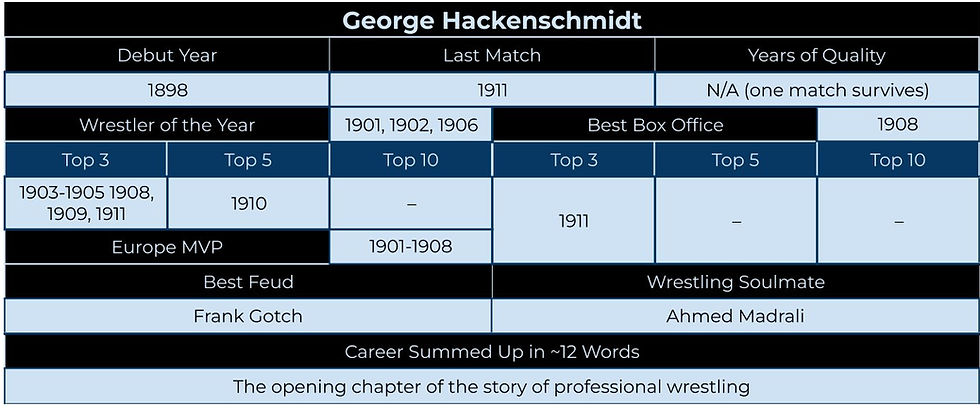
The words "Golden Age" get bandied about very easily in wrestling circles. Every fan has a favourite period of time when it comes to their fandom. Whether it was during their lifetime or when you delve into the archives.
My personal favourite eras are the “Five Star” era of NJPW in the previous decade as an era I lived through, and the Kings' Road era of AJPW as my favourite historical period.
For some, the era of Hackenschmidt is one that they talk and write about in glorious terms in retro content. Now, how can that be a thing when there is hardly any footage of the guy? Only in August of 2024 did footage of George turn up. It’s 25 minutes long. It features a match against Joe Rogers in an environment that saw a wrestling surface with no elevated squared circle and no ropes.
For a second I thought I was watching Choco Pro!
With an ending that saw a botched German Suplex, it is a decent match that could have been better had there been a tope suicida in the match… ***
(Sorry I was in my Social Suplex Newsletter History Man mode for a second there.)

One reason this era is The Golden Age to some is that what was happening was believed to be “honestly contested”. Whether that is the case is another story. But in a world where reality ruled, it was Hackenschmidt’s showmanship that he learnt while in Great Britain that made him The Guy of this age.
Born in what is now the city of Tartu in Estonia, an accident in the engineering factory where he held a job to help fund his foray into weightlifting saw him in the examination room of Dr. Vladislav Krajewski – who was also in service of Emperor Nicolas II of Russia. Dr. Vlad was also the founder of a sports club in St. Petersburg and, upon looking at George and his physique, invited him to the city he worked in to learn to be a pro wrestler.
George would win the “national championship” in weightlifting, emphasis on those speech marks considering Vlad was the organiser. Then, George would win bronze in the “10 events” event in the 1898 World Weightlifting Championships in Vienna, which was a competition that amalgamated the following into a decathlon
the one-hand snatch
simultaneous press of two dumbbells
simultaneous jerk of two dumbbells
one-hand press in military style
one-hand press in straddling style
one-hand press continuously in military style with 50.2 kg
one hand press continuously in straddling style with 50.2 kg
two-hand press
two-hand jerk
two-hand press continuously in military style with 100 kg
Also in that week, George won gold in the Openweight competition in the European Greco-Roman Wrestling Championships also in Vienna. Hackenschmidt had also had success in the pro ranks, beating Paul Pons, the French wrestler who would become an Observer Hall of Famer in 2019.
After a mandatory stint in the army that lasted 5 months, George entered tournaments both in Moscow and his new hometown – winning both. The Moscow tournament lasted 40 days according to folklore, with the Estonian taking part in 3-5 matches per day!
He also won something called the “World Championships of Wrestling”, which was not linked to the World Wrestling Championships governed by United World Wrestling in two weight classes, heavyweight and lightweight.

In June 1900, George would earn 2,500 francs a month and had gathered financial backers who were investing in the wrestler on a level unmatched by other sportsmen of his era. Hackenschmidt would prove his worth to his sponsors by winning tournaments in Moscow and St. Petersburg and become the top draw in Europe and the world as the 1900s commenced.
He toured England, wrestling under catch-as-catch-can rules against the best in the country in what was a booming industry in the first decade of the 20th century.
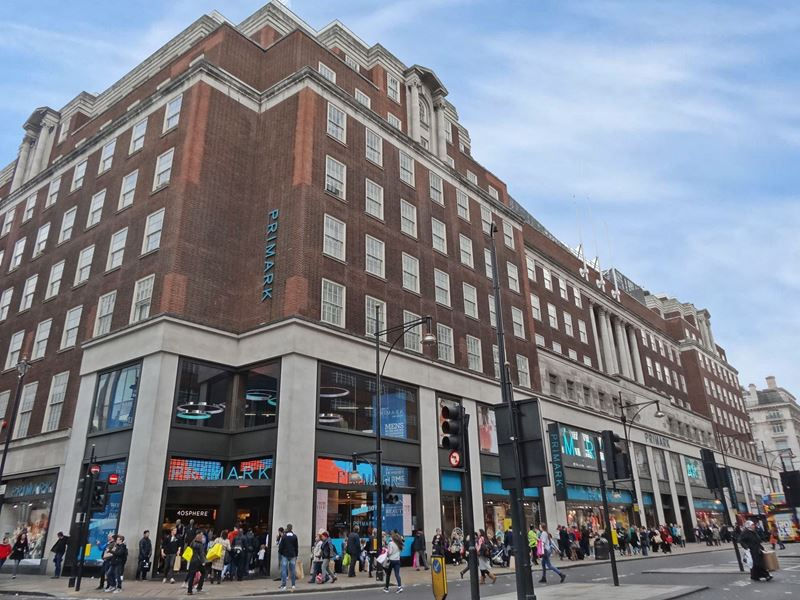
Events taking place in buildings such as the Royal Albert Hall, the Oxford Musical Hall (which is now the Primark on Oxford Street), Ibrox Stadium in Glasgow and The Palace Theatre in Manchester were a hot ticket in a sport that was in the conversation for being the No.1 sports / entertainment industry in Britain at this time. This is astonishing considering that Britain had no Greco-Roman tradition, but the English and Scottish public have always been fascinated by characters – for better or worse (yes, I’m looking at you Boris Johnson) – and while Hackenschmidt was learning the showmanship part while on British shores, the British public was interested in someone who looked larger than life.
Hackenschmidt would get 10,000 into The Olympia in London for a match against Ahmed Madrali. For comparison, World Championship Wrestling did 3,000 for a house show in the same building in 1991 – a building that could still do 10,000 (and did for a Chris Eubank vs Lindell Holmes boxing fight in 1993.)
Hackenschmidt then went to the U.S. and defeated Tom Jenkins – the American Champion after he beat Frank Gotch in a big shock – in Madison Square Garden in two straight falls to become the first undisputed World Heavyweight Champion. His popularity now transcended to the States, with President Theodore Roosevelt reportedly stating that “if I wasn’t President of the United States, I would like to be George Hackenschmidt.”

Cagematch only has George Hackenschmidt successfully defending the title once in his time as champion, which is the match against Rogers the footage of which popped up on the internet in 2024. Obviously, accounts of what matches were title or non-title matches from that inaugural World Title reign are murky and hard to substantiate, so when Hackenschmidt faced Scottish champ Alex Munroe at Ibrox, and Ahmed Mundrali at the Olympia Hall in London, records are vague as to the stakes.
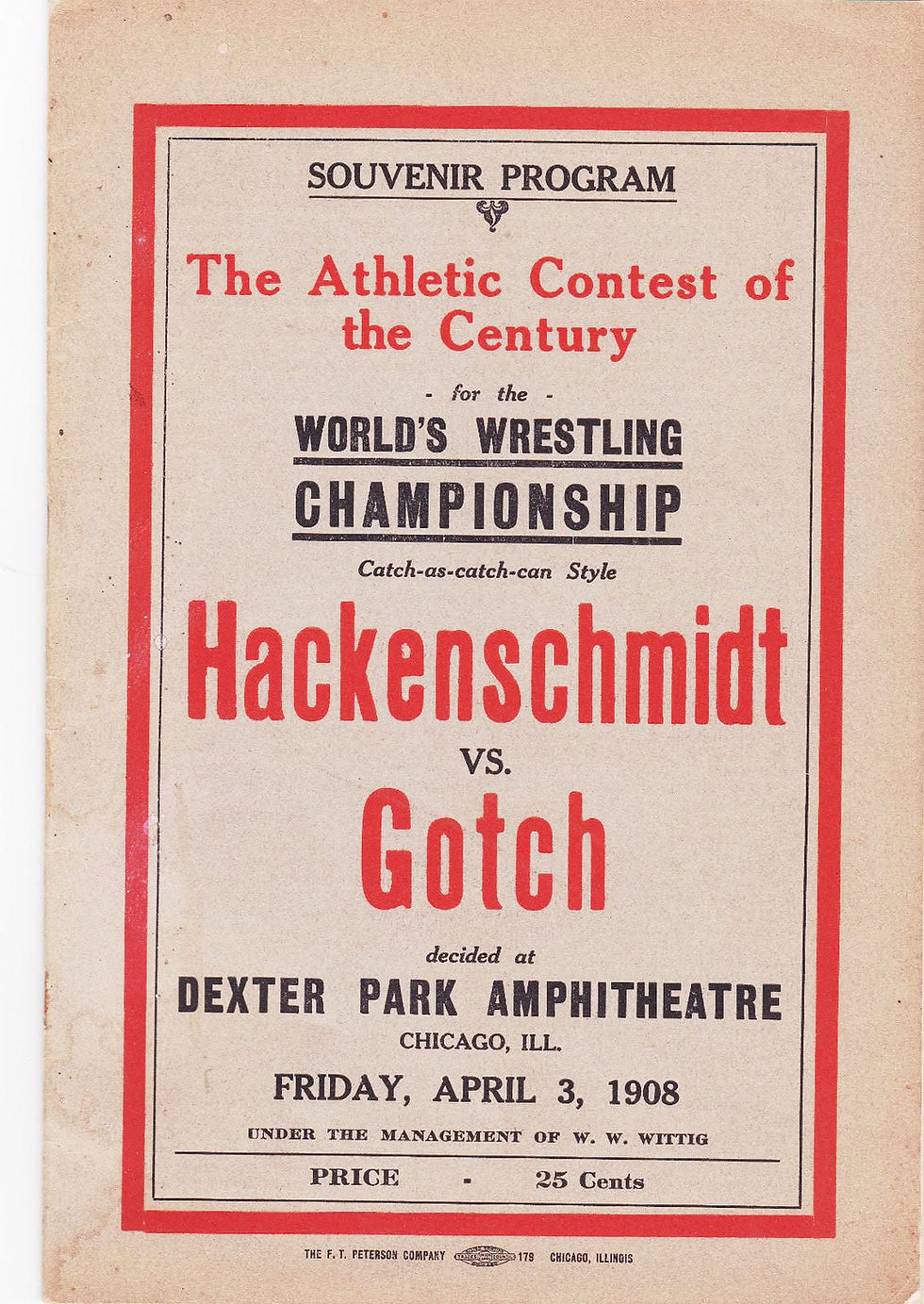
While George Hackenschmidt was touring Britain, Frank Gotch was cementing himself as the No.1 American, and a boat ride across the Atlantic Ocean later, the pair faced off in Chicago’s Dexter Park Amphitheatre on April 3, 1908.
Gotch had challenged Hackenschmidt previously, after the Estonian’s win over Jenkins but George ignored Gotch at the time. In his mind, someone who already lost to a man that he had dispatched so easily in New York made little sense for him, and also made not as much money for him as doing dates in England.
The problem for Hackenschmidt was that the English public were falling out of love with wrestling. A Madrali rematch didn’t draw as well as the first match, mainly because of an expose in newspapers about how legitimate wrestling might actually be – headed by Georg Lurich, a fellow Estonian, who was bitter at not getting a match against Hackenschmidt. Lurich would say that Jenkins had got the match in MSG and not him in London because Jenkins agreed to “take a dive.”
The match against Frank Gotch lasted 121 minutes according to Cagematch, two-and-a-half-hours according to John Molinaro’s Top 100 Wrestlers of All Time book. The Hackenschmidt bio in Molinaro’s book says that the bout was reputed to be a shoot, showing the murkiness to what the events around the industry were.
Stories were that George showed contempt for Gotch and American wrestling in the build up, refusing to take part in a public workout at the local athletic club as arranged in negotiations. It was also said that Hackenschmidt didn’t arrive in Chicago in the best conditioning, and apparently it showed in the 2 out of 3 Falls match.

Gotch used his speed to cause George problems, as did his rough tactics. At one point, Gotch hit a blow to Hackenschmidt’s nose. A clash of heads also bloodied George. A frustrated George complained to the referee about Gotch’s tactics and also asked that Gotch be forced to take a hot shower to get rid of an abundance of oil on his body. The official rejected the requests.
In a first fall that lasted 2 hrs, a stalemate had formed but then as that clock turned to 2:00:00, Hackenschmidt was forced against the ropes. Gotch tore him away and after 3 minutes of controlling the mount, trapped George in the toe hold submission and got a submission to win the first fall, at least according to some reports.
Jonathan Snowden in his book Shooters says that Hackenschmidt simply quit due to being exhausted after such a long contest, with his conditioning nowhere as good as it was when he went 166 minutes with Kara Ahmed eight years earlier. (But there’s also a chance that the 1900 match was legit and the Gotch match in 1908 wasn’t.)
The Washington Post would see a reporter almost gleefully write about the finale in a retrospective on the match:
...Frank sat on (Hackenschmidt), got his toe hold, and very slowly bent his ankle back until it was nearly broken. The German wrestler, unable even to roll over to his back, screamed. This was before the days of grunt and groan wrestlers, and it was a real scream.
FWIW, the reporter also said that “the German” was carried out and that six months later he was still “crippled”
Shows how murky the details actually are.
The words “I surrender the championship of the world to Mr. Gotch” or “you can have it, Mr. Gotch” were what Hackenschmidt said as he stood up and shook the hand of Frank – depending on the source. As stipulated in the agreement for the match, both men went to their locker rooms for a 10 minute break. Gotch returned, Hackenschmidt didn’t
Gotch was the new world champion via a second-fall forfeit.
Hackenschmidt’s good grace in his defeat – calling Gotch “the greatest man by far I’ve ever met” – was reversed later when he publicly said that Gotch repeatedly fouled him, and that he was “victimized” by Americans, and called for a rematch to take place on his home continent, writing in a letter to the Daily Mail that the people at ringside were all “prejudiced” against him. (Not to be the last time that the word "prejudiced" and the Daily Mail were in such close proximity.)
That rematch happened three years later, but again in Chicago. This time, the venue was the home of the White Sox, Comiskey Park. This particular night saw events that I can say were a lot less “predetermined” than the World Series that took place in the same ballpark in 1919.

Shenanigans were prevalent before the September 4th, 1911 match. A few weeks before the contest, Hackenschmidt tore his knee up in training. Stories vary on who the training partner was. Dr. Ben Roller is the man that George said was his sparring partner that day when Roller’s right foot struck Hackenschmidt’s knee which had been a body part that George had struggled with in his career, suffering from “Housemaid’s Knee” (a term for prepatellar bursitis, the inflammation of the fluid-filled sac located between the skin and kneecap.) This is easily caused by trauma to the knee in the grappling game by the rolling round in catch-as-catch-can training.
But a catch wrestler named Ad Santel would claim to Lou Thesz in the decades after that he was paid 5 grand ($160,000 in today’s money) to sabotage Hackenschmidt in training.
But wrestling being wrestling all these stories were being contradicted, sometimes by those who originally told the story. George would say later that his sparring partners for the match were Gus Schoenlein, Jacobus Koch, and Wladek Zbyszko, as well as Roller. Santel’s name never came up by anyone who was actually in the camp.
Hackenschmidt wanted to pull out of the match but was persuaded to go ahead, and according to some accounts was told falsely that Gotch had messed his neck up in training.
Some historians have claimed that the pair of combatants agreed to share out the first two falls with Gotch winning the final fall of the 3 fall contest. But apparently Gotch had other plans, targeting the obvious weakness of George's knee, shooting on the former champ and winning the match in two straight falls in less than 30 minutes.
A match where one of the participants really shouldn’t have been out there failed to live up to the hype. Fans felt ripped off and as a result the Chicago market was weakened for many years after. Hackenschmidt would retire shortly afterwards.
He was preparing for a match with the hot shot Hungarian Stanislaus Zbyszko for June of 1912 but the right knee that was his downfall the previous year was in so much pain that walking was a struggle. Surgery was needed and Hackenschmidt opted to retire
George would go on to write six books, all about physical fitness and welfare. He spent his days post-wrestling in London and would pass away in the St. Francis Hospital in Dulwich in South London, and was cremated in the West Norwood Cemetery, one of the “Magnificent Seven” cemeteries in the capital of the UK.

Every sport’s story needs to be told with its first superstar as part of that story and George Hackenschmidt is that star for pro wrestling. His bodybuilding physique, his aura that helped a sport gain popularity in a land that didn’t do wrestling beforehand, and his technical skills that were unmatched for years to come make “The Russian Lion” one of the most important figures in the story of pro wrestling.
G.O.A.T. 100 Portal
Links to all GOAT100 profiles published so far
G.O.A.T. 100 Image Grid


Comments